Get Your Copy:
The Cyber Resilience Act (CRA) Cheatsheet

Open any vulnerability dashboard right now and you'll see the same thing every security team sees: more findings than anyone could review in a lifetime, ranked by severity scores that all cluster near the top. Roughly 48,000 new CVEs were published in 2025 alone, and the average program has bandwidth to remediate somewhere between 10 and 15 percent of its backlog in a given month. That gap between what gets found and what gets fixed isn't a staffing problem. It's noise, and it's been mistaken for a risk picture for long enough that most teams have stopped questioning it.
Vendors have started layering exploitability and reachability signals on top of severity scores, flagging whether a CVE has a known exploit in the wild or whether the vulnerable function is actually called by application code. That's a real step past CVSS alone, and it does cut some findings out of the queue. But exploitability and reachability answer "can this be exploited," not "does it matter here." A reachable, exploitable vulnerability in an internal tool with no sensitive data behind it is a different risk than the identical vulnerability in a service with a direct path to payment data, and exploitability scoring alone can't tell those two apart. Without the business and architectural context to make that distinction, exploitability and reachability data just re-sorts the same pile into a slightly different order. It doesn't reduce it.
Noise doesn't come from one bad scanner. It comes from the fact that every scanner you add reports its own findings in isolation, with no view of whether anything it flags actually connects to anything else. SAST grades code. SCA grades dependencies. Secret scanning grades commits. Each one is doing its job correctly, and each one is contributing its own independent stream of severity-ranked findings to a backlog that was already too large before it showed up.
That fragmentation was survivable when code shipped at human pace. AI coding agents have removed that constraint, and the backlog is growing with it. A developer opens a handful of pull requests a day; an agent working in the background can open dozens, and every one of them triggers its own pass from every scanner in the pipeline. The noise problem stopped being something a team could plan around once a quarter and became something that compounds with every commit an agent makes, which means the case for reducing it is no longer theoretical. It's urgent, and it gets more urgent by the day.
Adding tools to cover more of the stack feels like progress, and in a narrow sense it is. But it also means the noise compounds. Four scanners each reporting cleanly on their own slice of the product doesn't add up to a quieter picture of risk. It adds up to four separate streams of findings, none of which know about the other three, and that isolation is exactly what produces false positives and false confidence in the same breath. A scanner with no view of the environment has no way to know a downstream control already neutralizes what it just flagged, so it reports a real finding as urgent when it isn't. The opposite failure is just as common: without understanding how the surrounding system actually behaves, a tool can't verify whether a vulnerability it found is reachable in an actual attack path, which means genuine risk gets buried in the same pile as the noise around it.
The instinct is to sort the noise by severity and work top-down. That fails because severity measures how bad a vulnerability could theoretically be, not whether it's reachable, exposed, or exploitable in this specific environment. Two findings with identical CVSS scores can carry completely different risk depending on what's around them: one sits behind three layers of controls, the other has a direct path to production. A backlog sorted by severity alone treats those as the same problem, which is exactly why teams burn remediation capacity on findings that were never going anywhere while genuinely dangerous ones sit untouched further down the list.
Cutting through that noise isn't a matter of triaging faster or tuning the scoring model harder. It requires asking a different question of every finding, one severity scores were never built to answer: is this part of a path an attacker could actually walk right now, given what it connects to. And more importantly, how feasible is this path? If an exploit requires Tom Cruise to dangle dramatically from the ceiling, it’s unlikely to be prioritized by attackers. In other words, there is no simple solution that relies on a single score…which is exactly why context matters!
That's an execution-path question, not a severity question, and it changes what "important" means. A CVSS 9.8 sitting on a service with no route to anything sensitive isn't urgent, whatever the score says. A medium-severity finding sitting on a component that connects straight to a trust boundary might be the most important thing in the backlog. Severity describes a finding in isolation. An execution path describes what happens once you stop looking at scores and start focusing on the real impact to the business and how exposed the vertical to that impact.
Run that filter honestly and the backlog doesn't just get shorter, it changes shape entirely. What's left isn't a smaller version of the same list sorted the same way. It's a small, specific set of findings that are reachable and chained together into something an attacker could actually use, the kind of path where a component that passes its own scan cleanly still turns out to be one link in a route to something that matters.
None of this is an argument for buying another scanner. Another scanner adds another stream of severity-ranked findings, which is exactly the problem, not the fix. What's needed is something that doesn't produce its own isolated list at all: a way of seeing the product as one connected system, where a finding is judged by what it opens up rather than scored and filed on its own.
SAST, SCA, and secret scanning were built to grade their own slice of the product well, not to reason across slices, and no amount of tuning changes that. What's missing is a layer above all of them, one that holds architecture, data flows, and access paths in view together and asks the question none of the individual scanners can: does this finding sit on a path an attacker could really walk, given everything else true about this product right now.
The noise problem doesn't stay in security's backlog. Every finding that reaches a developer without context asks them to stop and chase down whether it's real, and often it isn't: a downstream control already handles it, the path doesn't exist, the function isn't even called. After enough of those empty chases, the rational response isn't more diligence. It's discounting the next finding, and the one after that.
That erosion is the real cost. It isn't just inefficient for security teams triaging a backlog. It teaches developers, correctly, that most of what lands in their queue isn't worth their time, which means the findings that actually matter now have to fight through that learned skepticism to get acted on at all. The fix isn't more findings or sterner tickets. It's surfacing only what's already been checked against the path it would need to travel.
The measure of a good vulnerability management practice was never how many findings you closed this quarter. It's whether what's left in front of your team, after the noise is filtered out, is actually worth their time. A shorter list sorted by the same broken signal isn't progress. A list built from real execution paths, however short, is.
At Prime, this is the case for correlating findings against real execution paths across the whole product rather than triaging them one severity score at a time, so what reaches your team is what an attacker could actually walk, not everything a scanner happened to flag.
Ready to see what's left once the noise is filtered out? Learn more at primesec.ai.

For the last decade, the pull request has been the moment a developer's work paused long enough for someone else to look at it. That pause is what turned the PR into a checkpoint. A reviewer read the diff and checked it for whatever could go wrong: bugs, broken business logic, security holes. Nobody designed the PR to be a security control. It became one because it was the last place in the software lifecycle where a person reliably paid attention before code shipped.
Now agentic development is breaking the math that made the diff work. PRs are getting bigger and more frequent at the same time, and the pause they run through hasn't gotten any longer. The unit of review is shifting under security's feet.
Before anyone scanned PRs, security tools ran against whole repositories, and compliance programs accepted that as review. The results were unusable: thousands of noisy findings and no way to tell which ones mattered. So the industry moved down to the diff. It was the easiest unit to work with, not the right one.
Look at what a pull request is actually made of: a diff, a comment thread, and an approval button. None of it was ever the control. It was just tooling built for the moment someone paused to review the work. The pause survived on three conditions. PRs stayed small enough to read closely. Rare enough that every one of them got read. And the review produced a handful of issues that a developer will actually fix.
Agentic development is killing all three at once. Cursor's enterprise data shows average PR size more than doubling, with volume up another 25% on top. Mega PRs, 1,000 lines or more, are now routine. A Microsoft study of Claude Code and GitHub Copilot CLI users found adopters merging roughly 24% more PRs, hitting 50% in heavy-use weeks and holding there for four months. And bigger PRs carry more issues per review, pushing every comment thread past the point where developers stop reading it.
Any one of these would strain a review built around a careful pause. Together they take away everything it needed: time per PR, few enough PRs to give each one that time, and findings scarce enough to get fixed.
Volume is only half the problem. The other half is what's landing inside each PR. CodeRabbit's analysis of AI-co-authored pull requests found they carry roughly 1.7 times more issues than human-only PRs, including 1.5 to 2 times more security-relevant findings like improper credential handling and insecure object references. High-issue outliers cluster in AI-assisted work. So a reviewer doesn't know which PR needed the slow read until they've already skimmed past it.
Compliance programs accept PR approvals as evidence that changes were reviewed before deployment. Today, the audit trail looks exactly like it did three years ago. What's changed is what that approval means. It used to mean someone read the code. Now, on a 1,500-line agent-written PR that arrived with six others that morning, it mostly means the person ran out of reasons to keep it open. The requirement is still being met on paper. Whether real security is happening underneath is a separate question, and no audit is built to ask it.
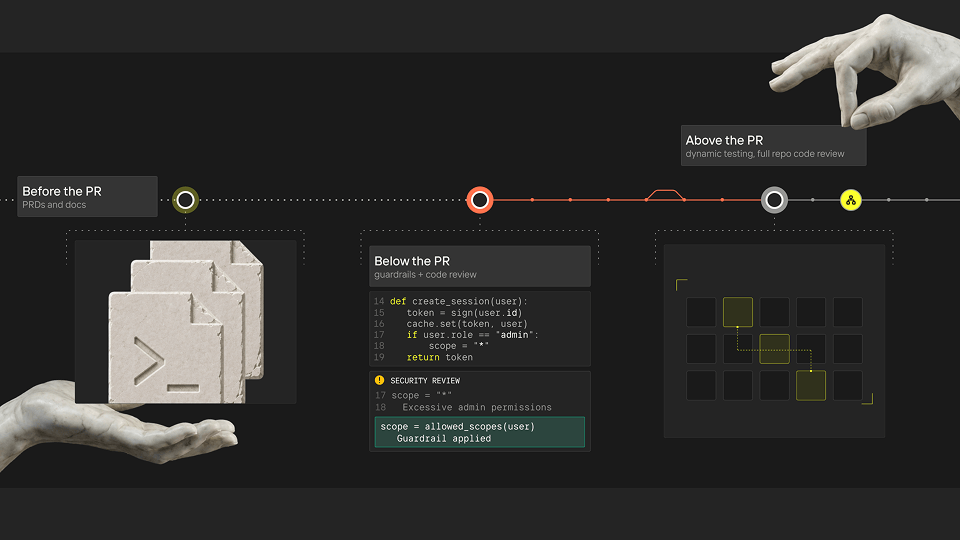
Once you see the PR as a stand-in for attention rather than a control in its own right, the question changes. Scaling review to handle more, bigger PRs is the wrong project. The real question is where that attention needs to live now that it can't all sit in one checkpoint.
Some of it belongs below the PR, where an agent makes decisions in real time and context can be applied before a diff exists. Some belongs above it, at the repository level, because a vulnerability spread across several small, reasonable PRs never shows up in any single diff. And some belongs before the PR entirely, in the architecture and design decisions that shape what an agent, or a developer, can build in the first place.
The repository level is the one that should give people pause, because the industry has been there before. Repo-wide analysis is where this story started, and it collapsed under its own findings. But that was a context problem, not a level problem. The tools flagged patterns without knowing what was reachable, what was exploitable, or what mattered to the product. Analysis that traces attack vectors and validates exploitability before it surfaces anything produces the one thing the old scanners never could: a short list. Five findings a developer will actually fix, with a risk score that is attached to a product. The comment-count condition, restored at the level the industry abandoned.
No, PR reviews aren't dead. The pause they measured is.
Reviews stay in the program as one place security happens, not the primary one. Attention has to live where decisions live now: in the design before code exists, in the code as it's written, in the repository as it evolves. This is what we do at Prime, that's the architecture: review the design, guard the code, trace attack vectors across the repo, dependencies, and cloud continuously.

For years, black-box penetration testing has relied on a simple premise: simulate an attacker who knows nothing about the system. The tester starts outside the application, discovers endpoints and functionality, infers architecture, and gradually builds an understanding of how the product works.
That assumption is outdated.
A serious attacker already has more information than the traditional black-box model assumes. Source code routinely leaves organizations through compromised insiders, contractors, repositories, legitimate access obtained under false pretenses, and AI-assisted development workflows. Source secrecy is no longer a strong foundation for offensive security.
If applications need to remain secure when an adversary understands how they work, testing needs to begin from the same vantage point. That is attacker parity.
Source-code theft does not require a dramatic breach.
The North Korean IT worker campaign illustrates the problem. The FBI has warned that DPRK IT workers use false identities to obtain legitimate employment with U.S. companies and then use that access to steal proprietary information. In January 2025, the FBI specifically warned that workers had held stolen source code and other proprietary data for ransom.
Google Threat Intelligence has documented the same campaign at significant scale. The important security lesson is how access is obtained. An attacker hired under a false identity receives credentials, repository access, internal communications, and the same development environment as other employees. From the application's perspective, that access is legitimate.
AI-assisted development creates another path. Developers now work across coding assistants, model APIs, IDE extensions, autonomous agents, and third-party development services. When proprietary code is submitted to an external AI service, that service becomes part of the system trusted with the code. NIST's Generative AI Profile identifies data privacy, information security, third-party components, and data governance as areas organizations need to manage when deploying generative AI.
Source confidentiality is a weak assumption for an offensive security strategy.
A black-box tester spends part of every engagement reconstructing information the engineering organization already possesses. They discover APIs, map routes, infer trust boundaries, experiment with authentication flows, and probe application behavior to understand the architecture.
That work is useful when the objective is to measure what an outsider discovers from an exposed application. It is a limited model of what a capable adversary does.
Source access changes the economics of attacking an application. Reconnaissance is faster, hypotheses are easier to form, and security controls are inspected directly instead of inferred through trial and error. Authorization logic, hidden endpoints, dependency behavior, and implementation assumptions all become easier to investigate.
The attacker spends more time searching for exploitable weaknesses while the black-box tester spends valuable engagement time rediscovering how the product works.
We already accept this model with open-source software. Security controls in an open-source application must withstand attackers who can inspect the implementation. Proprietary applications deserve the same standard.
Defenders already possess an extraordinary amount of useful security context. They have the source code, architecture, security requirements, dependencies, deployment model, and historical design decisions.
White-box penetration testing puts that context to work.
A tester who understands the implementation moves directly into deeper questions about exploitability. They trace authorization logic across services, follow data through trust boundaries, examine how security controls are implemented, and identify places where implementation differs from design intent.
That context also makes it easier to investigate attack paths rather than isolated findings. A minor authorization weakness becomes critical when combined with a particular identity path or cloud configuration. Source code provides only part of that picture. Effective Product Security testing also needs architectural context, identity, infrastructure, dependencies, and application behavior.
A capable attacker uses whatever information they obtain. Defenders should use the information they already own.
A white-box assessment still represents a point in time. The application starts changing again as soon as the engagement ends.
New code lands, dependencies change, APIs evolve, infrastructure is modified, and authorization logic gets refactored. AI coding tools and development agents have accelerated software production and increased the volume of changes security teams need to understand.
Attackers keep studying the product as it evolves. Offensive security needs the same continuity.
Continuous white-box pentesting preserves application context and repeatedly evaluates what is actually exploitable as the product changes. At Prime, that means connecting code with architecture, dependencies, cloud resources, application behavior, security decisions, and attack paths so testing starts with the context required to investigate meaningful risk.
Black-box testing remains useful for understanding what an unauthenticated or opportunistic outsider discovers. It tests externally observable attack surface and exposes weaknesses in authentication, configuration, discovery, and application behavior.
It should not define the upper bound of an offensive security program.
A motivated adversary has source code, internal documentation, credentials, architecture details, or extensive time to study how the product works. Your security team already has more context than that.
Use it.
Treat source access as part of the threat model, give testers the information advantage available to defenders, and test applications from the perspective of an informed adversary.
Ready to see how Prime continuously tests applications with the same product context an informed attacker would? Learn more at primesec.ai.

The Cyber Resilience Act (CRA) is the European Union's most significant product security regulation since GDPR. Formally adopted as Regulation (EU) 2024/2847, the CRA establishes mandatory cybersecurity requirements for all products with digital elements sold in the EU market. Non-compliance carries penalties up to €15 million or 2.5% of global annual turnover, and products that fail conformity assessment lose EU market access entirely.
Unlike previous frameworks focused on organizational security practices, the EU CRA is product-centric. Every software product must prove security throughout its lifecycle to receive CE marking, which signifies that products sold in the EEA (European Economic Area) have been assessed to meet high safety, health, and environmental protection requirements. For security leaders, this regulation formalizes a long-standing principle: security must be considered at the design phase, not retrofitted after implementation. This guide explains what the CRA requires, who it affects, and how to build compliant practices.
The Cyber Resilience Act is an EU regulation setting mandatory cybersecurity requirements for all products with digital elements sold in the European market. Formally adopted as Regulation (EU) 2024/2847 and entering into force on December 10, 2024, the CRA represents the most far-reaching product security regulation the EU has enacted. It is product-centric, requiring every software product, from standalone applications to embedded firmware to SDK components, to prove security throughout its entire lifecycle, from initial design through end-of-life support.
Product security failures have grown too consequential and too widespread for voluntary standards to fix. When connected devices reach hundreds of millions of households and businesses, a single architectural shortcut can cascade into infrastructure-level disruption. As shown by the October 2016 Dyn attack, attackers compromised over 600,000 IoT devices by exploiting factory-made usernames and passwords, leaving services like Twitter, Netflix, GitHub, and others unreachable for hours.
The vulnerability was not a coding error that testing would have caught but a product design decision. Although GDPR covers the handling of personal data and NIS2 covers critical infrastructure network security, neither imposes obligations on the manufacturers whose design choices created the attack surface in the first place. The CRA fills this gap by making secure-by-design a legal requirement at the point of manufacture, documented and auditable before products reach the market.
The CRA differs from NIS2, DORA, and ISO 27001 in one key way: it regulates products, not organizations. While NIS2 requires essential service operators to implement security measures, and ISO 27001 certifies organizational security management systems, the CRA requires each individual product to meet specific security requirements and undergo conformity assessment before receiving CE marking for EU market access.
This product-level focus means compliance cannot be achieved through organizational policies alone. Each product requires documented evidence that security was considered and implemented throughout its development, starting at the design phase.
The CRA follows a phased implementation timeline:
| Date | Milestone |
|---|---|
| December 10, 2024 | CRA enters into force |
| September 11, 2026 | Vulnerability reporting obligations begin |
| December 11, 2027 | Full compliance required for all essential requirements |
While December 2027 is the full compliance deadline, September 2026 introduces mandatory vulnerability reporting. This means organizations need:
For companies selling to EU customers, this provides an implementation window to build the practices that form the foundation of CRA compliance, including design-stage security reviews.
The CRA establishes a tiered penalty structure based on violation severity:
| Violation Type | Maximum Penalty |
|---|---|
| Essential requirements violations | €15 million or 2.5% of global annual turnover |
| Other obligation violations | €10 million or 2% of global annual turnover |
| Incorrect or incomplete information | €5 million or 1% of global annual turnover |
Beyond financial penalties, non-compliance affects:
The CRA specifically calls out four classifications of software providers:
Organizations that design, build, or brand products bear primary responsibility for CRA compliance.
This includes:
Entities that bring products from outside the EU into the EU market must verify compliance before distribution.
Entities in the supply chain that make products available.
Open source software developed outside commercial activity is generally exempt.
However:
Does the CRA apply to companies outside the EU?
Yes. The CRA applies to any entity that places products with digital elements on the EU market, regardless of where that organization is headquartered. Non-EU manufacturers must comply with all essential requirements to receive CE marking and maintain EU market access.
The CRA applies to products with digital elements (PDEs), defined as any software or hardware product that connects directly or indirectly to a device or network. The scope is deliberately broad to cover the interconnected nature of modern digital products.
Pure SaaS offerings, where no software component is downloaded or installed, are generally excluded from the CRA's scope. However, most modern SaaS products include downloadable elements that bring them into scope:
If your SaaS product includes any downloadable component, that component falls under CRA requirements, and the security of that component must be proven through design-stage practices.
The CRA establishes risk categories with corresponding compliance requirements:
| Category | Examples | Assessment |
|---|---|---|
| Default (non-critical) | Most software applications | Self-assessment |
| Important Class I | Identity management, browsers, password managers | Self-assessment with harmonized standards or third-party |
| Important Class II | Hypervisors, firewalls, HSMs, smartcard readers | Mandatory third-party assessment |
| Critical | Smart meters, smartcards, secure elements | European cybersecurity certification |
What is required for CRA conformity assessment?
CRA conformity assessment requirements depend on product risk classification. Default (non-critical) products allow self-assessment. Important Class I products can self-assess with harmonized standards or use third-party assessment. Important Class II products require mandatory third-party assessment by notified bodies. Critical products require European cybersecurity certification.
The CRA's essential requirements are defined in Annex I of the regulation and are divided into two categories: security requirements for the product itself, and vulnerability handling requirements for ongoing support.
1. Security by Design
Products must be "designed, developed and produced" with appropriate cybersecurity levels based on risk assessment. This requires documented evidence that security was considered during architectural decisions, not added after implementation. The regulation states:
"Products with digital elements shall be designed, developed and produced in such a way that they ensure an appropriate level of cybersecurity based on the risks." (CRA Annex I, Section 1.1)
2. Secure Default Configuration
Products must ship with secure settings by default: least-privilege access, no default credentials, and hardened configurations aligned to intended use. Configurations that require user action to become secure do not meet this requirement.
3. Data Protection
Products must ensure confidentiality, integrity, and availability of data through appropriate mechanisms including encryption, access controls, and data minimization.
4. Resilience and Availability
Products must resist denial-of-service attacks and minimize negative impacts on other network resources.
5. Attack Surface Minimization
Products must minimize external interfaces, disable unnecessary services, and limit the impact of potential compromises through segmentation and containment.
6. Software Bill of Materials (SBOM)
Manufacturers must identify and document all software components, including dependencies, in a machine-readable format — either SPDX or CycloneDX.
The CRA's most consequential requirement is not SBOM generation or vulnerability scanning. It is the mandate for security by design. Article 13 requires manufacturers to "exercise due diligence when integrating components" and ensure products are "designed, developed and produced in accordance with essential requirements." The regulation specifies:
"Manufacturers should therefore ensure that all products with digital elements are designed and developed in accordance with the essential cybersecurity requirements laid down in this Regulation." (CRA (9))
Security by design under the CRA means integrating security considerations from the earliest product development phases, during architectural decisions and feature design, not retrofitting security after implementation. The regulation requires documented evidence that security was considered during design, rather than tested only after development.
"Products with digital elements shall be designed, developed and produced in such a way that they ensure an appropriate level of cybersecurity based on the risks." (CRA Annex I)
We continue to see an acceleration in the amount of focus that the design stage is getting from a cybersecurity risk management perspective, driven not solely by this act, but by global cybersecurity organizations and regulators alike.
Most organizations have to this point invested substantially in code-level security tools:
These tools serve important purposes, but they operate after code exists.
The CRA asks a different question: What security decisions were made when this feature was designed?
When a feature moves from specification to implementation, the security-relevant decisions happen early. What data will this access? How will authentication work? What happens if this component is compromised? By the time code exists to scan, these architectural decisions are already made.
Answering the CRA's design-stage question requires security review during the design phase, with documented evidence that can satisfy conformity assessment. This creates a gap for most organizations: they have tooling for code-level security, but not for design-stage security review.
The CRA creates new compliance obligations that existing tools and regulations do not cover:
| CRA Requirement | Traditional AppSec Tools | Other Regulations (NIS2, DORA, ISO 27001, etc.) | Compliance Gap |
|---|---|---|---|
| Security considered during design phase | Not Addressed | Not Required | CRA-Specific Gap |
| Documented architectural security decisions | Not Addressed | Not Required | CRA-Specific Gap |
| Risk assessment before implementation | Not Addressed | Organizational risk assessment (not product-level) | CRA-Specific Gap |
| Code vulnerability detection | SAST, DAST, SCA | ISO 27001, DORA, NIS2 | Best-Practice / Covered |
| Software Bill of Materials | SCA tools | Federal (US) [EO 14028, FedRAMP, some sectoral [PCI DSS, FDA Section 524B], DORA | Best-Practice / Covered |
| Vulnerability disclosure and handling | Detection only | NIS2 incident reporting | Partially Covered |
| Product-level conformity assessment evidence | Scan reports (code-level only) | ISO 27001 (org-level, not product) | CRA-Specific Gap |
These security-by-design requirements create the primary compliance gap organizations must close.
Prime Security's Agentic Security Architect closes the design-stage gap by bringing security review to where the CRA requires it: before code is written. Prime identifies security risks in planned work and creates the documented evidence that conformity assessment requires.
Prime analyzes feature specifications, architectural decisions, and integration plans as they are created, not after they are implemented.
When a developer writes a Jira ticket describing a new feature, Prime automatically:
This shifts security review to where the CRA requires it, the design phase, while ensuring consistent coverage across all development activity.
Manual security design reviews can satisfy CRA requirements in theory. In practice, they create an impossible tradeoff. The CRA demands documented security consideration for every feature across every product. Achieving full coverage manually means either hiring a security architect for every development team or slowing releases to a crawl while a small team reviews everything. Most organizations end up with partial coverage and gaps in their conformity documentation.
Prime resolves this tradeoff. By automating design-stage review, organizations achieve the continuous coverage CRA requires without blocking development. Security teams maintain oversight and make final decisions, but the baseline analysis and documentation happens automatically, at the pace of development.
| CRA Compliance Metric | Existing, Manual Processes | With Prime |
|---|---|---|
| Feature review coverage | 10-30% | 100% |
| Security monitoring frequency | Periodic or ad-hoc | Continuous |
| Development velocity impact | Significant slowdown for full coverage | Accelerated |
| Audit documentation readiness | Incomplete with gaps | Complete and audit-ready |
Security by Design (Annex I, Part I)
The CRA requires that products "be designed, developed and produced in such a way that they ensure an appropriate level of cybersecurity based on the risks."
Prime ensures that security teams are able appropriately manage the risks of every project by making sure that features are designed securely from the beginning.
Risk Assessment (Statement 37)
The CRA also mandates that “ Manufacturers should ensure that software made available under those conditions is released only following a risk assessment and that it complies to the extent possible with the security requirements relating to the properties of products with digital elements laid down in this Regulation.”
Prime's agent assesses the risk of both new components and existing software based on the rules and regulations set out by each individual company, regardless of size or industry..
Due Diligence on Components (Article 13.5)
The regulation requires manufacturers to "exercise due diligence when integrating components sourced from third parties."
When development plans include third-party integrations, Prime analyzes the security implications of those integrated design decisions.
Effective and Regular Testing (Annex I, Part II)
The CRA mandates that manufacturers "apply effective and regular tests and reviews of the security of the product."
Prime fits into your existing workflows between security and engineering, continuously reviewing development activity.
Technical Documentation (Article 31)
“The technical documentation shall contain all relevant data or details of the means used by the manufacturer to ensure that the product with digital elements and the processes put in place by the manufacturer comply with the essential cybersecurity requirements set out in Annex I.”
Prime creates persistent, auditable records of security decisions, recommendations, and reviews, producing the documentation required for conformity assessment and market surveillance.
NIS2 (Directive 2022/2555) applies to essential and important entities operating critical infrastructure and requires organizational security measures, incident reporting, and supply chain security. The CRA applies to products regardless of who uses them.
The key differences:
Most organizations that need to comply with NIS2 will also need to comply with CRA. A software company providing products to healthcare organizations might need NIS2 compliance as an important entity and CRA compliance for each product sold.
The Digital Operational Resilience Act (DORA) focuses on financial entities with requirements for ICT risk management, incident reporting, and third-party risk management.
While DORA regulates organizational resilience, CRA focuses on product security. Financial services companies subject to DORA that also manufacture software products need CRA compliance for those products in addition to DORA compliance for their operations.
ISO 27001 is a voluntary certification for information security management systems. The CRA is mandatory regulation with legal enforcement. ISO 27001 certification can support CRA compliance by showing mature security practices, but does not substitute for product-level conformity assessment and technical documentation.
Yes. The CRA applies to any organization that places products with digital elements on the EU market, regardless of where the company is based. If you sell software, hardware, or connected products to EU customers, you need to meet CRA requirements and obtain CE marking for those products.
Pure SaaS offerings with no downloadable components are generally out of scope. However, most SaaS products include elements that bring them in — browser extensions, desktop or mobile apps, agent software, SDKs provided to customers, and CLI tools all fall under CRA requirements. If any component gets installed or downloaded by the user, that component is in scope.
Full compliance with all security requirements is due by December 11, 2027. However, mandatory vulnerability reporting to ENISA starts earlier, on September 11, 2026. That earlier deadline means you need documented vulnerability handling processes and reporting channels in place well before the full compliance date.
Traditional AppSec tools — SAST, SCA, and DAST — find vulnerabilities in code that already exists. Security by design means making security decisions during the architectural and feature design phase, before any code is written. The CRA requires documented evidence of the latter; code-level scan reports alone do not satisfy this requirement.
You need documented proof that security was considered during the design phase of each product, a software bill of materials (SBOM) in a machine-readable format, records of vulnerability handling processes, and technical documentation covering how your product meets the Annex I requirements. For higher-risk product categories, third-party assessment by a notified body is also required.
The Cyber Resilience Act formalizes what security teams have long advocated: security consideration at the design phase, with documented evidence. The regulation provides clear requirements and a defined timeline to build out security by design best practices. Prime Security closes the design-stage gap by bringing automated security review to the design phase, creating the documented evidence that conformity assessment requires while helping your security architects focus on the strategic decisions that need human judgment.
Request a Demo to see how Prime Security automates CRA-compliant security design reviews across your development organization.

Today, I’m proud to share that Prime Security has raised a $20 million Series A, led by Scale Venture Partners, with continued support from Foundation Capital and Flybridge Ventures.When Dima, Matan, Danny, and I started Prime almost two years ago, our hypothesis was simple: Security isn’t keeping up with development. Despite endless tools, day-to-day security engineering and architecture work still feels manual, fragmented, and slow.
We experienced this problem first-hand. Dima’s previous security teams at PayPal were always playing catch-up, while Matan, Danny, and I were delaying releases at Own because of last-minute security requirements. Even two years ago, this was a huge problem.
What we didn’t expect was just how fast development itself would evolve. Everyone became an engineer. AI-powered coding tools exploded. Velocity went through the roof, and the bottleneck for security? It got 5× worse.
We are building Prime to change that.
LLMs changed everything. But we didn’t see them as a replacement for security engineers; we saw them as a way to scale their judgment.
From day one, our vision has been to democratize security knowledge across every development team, to make security as embedded and accessible as code review.
That’s what Prime is building: an AI Security Architect - the super-tool security teams have always needed. An agentic system that autonomously reviews design work, identifies risks, and recommends mitigations, before a single line of code is written.
With Prime, security teams can finally cover all development work, not just the 5–10 percent they can manually review today. The result? Teams eliminate review backlogs, accelerate development and save millions in process costs, sometimes tens of millions annually, all while actually improving security outcomes.
It’s not reactive security. It’s preemptive security, where risks are understood and resolved at the design stage, long before they ever become incidents.
We’ve been lucky to work with some incredible early partners - PayPal, Qualtrics, ThoughtSpot, Bumble, Yext, Redis Labs, and many others who believed in our vision early on.
Together, we proved our hypothesis: Product Security teams require tooling that lets them move at the speed of modern development, without compromising on risk visibility.
It’s not about scanning code faster. It’s about thinking about security earlier, when architecture, design, and product decisions are being made.
We started by focusing on the design stage of the product development lifecycle, but that is just the beginning. The challenges of securing modern development don’t end there. They start there.
This Series A funding gives us the resources to go deeper, expand our agentic AI capabilities, and grow our teams across the U.S. and Israel, all with the goal of leading the next era of product security.
We believe security shouldn’t slow you down. It should help you move faster confidently.
That’s what Prime is here to do.
— Michael Nov, Co-Founder & CEO, Prime Security

Prime’s new platform accelerates development with automated security reviews and full visibility into design-level risks
NEW YORK CITY and TEL AVIV – December 9, 2025 – Prime Security, creator of the first Agentic Security Architect, today announced its $20M Series A funding. The round was led by Scale Venture Partners, with participation from Foundation Capital, Flybridge Ventures, and Ofir Ehrlich, CEO & Founder of Eon. The new funding will fuel Prime’s go-to-market expansion and accelerate development of its Agentic Product Security Platform, a growing suite of autonomous AI agents that continuously monitor, assess, and guide product security throughout the entire development lifecycle.
Modern development runs at machine speed, but security still operates like an assembly line, slow, manual, and dependent on scarce expertise. Today, security teams have the capacity to manually review only a small fraction of planned work before release, leaving the rest to chance. As AI-assisted coding accelerates development velocity, this gap keeps widening. Prime’s agentic platform automates this manual craftsmanship, transforming design-stage protection into a continuous, intelligent process that scales with engineering.
"Integrating security into the design phase has always been a technically challenging manual process. Prime's unique approach transforms this critical, time-consuming stage." said Ariel Tseitlin, Partner at Scale Venture Partners. "This team are both visionaries and operators. Having led technical, GTM, and security teams at companies like PayPal and Own, and scaled enterprise Product Security programs, they've experienced firsthand the problem they're solving. This combination of category-creation vision and deep operational expertise is what defines market leaders."
Prime Security is developing a new era of Product Security, where AI agents bring security into the design stage of every software project and feature. Its flagship product, the Agentic Security Architect, autonomously conducts security design reviews and proactively identifies design flaws across development work. By embedding directly into engineering workflows, Prime enables organizations to accelerate reviews, cut manual effort and cost by more than 60%, and achieve nearly full coverage across planned development tasks.
“Modern product development is changing in front of our eyes,” said Michael Nov, Co-Founder and CEO of Prime Security. “We founded Prime to redefine how security fits into this new world, with agentic systems that operate starting at the design phase, not after development. Our mission is to build security that scales with engineering instead of slowing it down.”
After starting to commercialize the product earlier this year, Prime won the Black Hat 2025 Startup Spotlight this summer and is already working with dozens of customers including PayPal, Qualtrics, Bumble, ThoughtSpot, Redis Labs, and others with development teams of over 200 engineers who are seeing significant impact including:
“At PayPal, we know that security must evolve as fast as the threat landscape,” said Shaun Khalfan, CISO at PayPal. “Prime Security’s autonomous, design-stage reviews give us continuous and adaptive visibility across our engineering ecosystem, enabling us to identify and address risks earlier in the software development lifecycle. This capability helps us move with speed and confidence to deliver for our customers and strengthen trust in our business globally.”
By providing continuous, automated security assessment of all planned work, Prime empowers security teams to focus on strategic architecture while ensuring comprehensive coverage of every feature, enhancement, and change flowing through the development pipeline.
ABOUT PRIME SECURITY
Prime Security provides an agentic-powered platform that enables security teams to detect, prioritize, and mitigate risks at the software design phase. Founded in 2023 and headquartered in New York with offices in Tel Aviv, Prime integrates with leading engineering tools to deliver 100% coverage of development efforts without slowing engineering down. The company is SOC2 Type II certified and backed by Scale Venture Partners, Foundation Capital, Flybridge Capital Partners and PayPal Ventures. For more information, visit the website.
Media Contact:
Morgan Grandi
morgan@primesec.ai

EVERY SINGLE COMPANY I speak to has adopted or is adopting AI code generation tools. Cursor’s ARR numbers don’t lie. Some companies are pretending they haven’t, calling it “just a pilot” or “a few devs experimenting.” Others are leaning all the way in because they have to. Dev teams are demanding speed. Leadership wants productivity gains. And honestly? These tools are good. Too good to ignore.
But here’s the thing: AI-powered development is already here. It’s loud. It’s fast. And it’s not waiting around for security sign-off. The train has left the station. Security’s still checking the schedule. Google says 25% of their code is now written by AI. If they got there that fast, your org’s not far behind. This isn’t hype. It’s happening.
Let’s not kid ourselves, most developers aren’t generating full-blown apps (yet), especially at mid-sized and larger companies. For now, it’s autocomplete. Maybe a helper function here and there. Seems safe. Harmless.
But we’ve seen this progression before. Autocomplete becomes “generate block.” “Generate block” becomes “why not ship it?” And suddenly, you’ve got AI-assisted infrastructure changes cruising toward production. There’s a Jira ticket. There’s some plan. But no one’s waiting for a security review. The specs are thin, the pace is insane, and the review process? Skipped, sidelined, or rubber-stamped. Just enough structure to ship, nowhere near enough to secure.
And here’s what makes it even scarier: a lot of these changes aren’t greenfield. They’re not new apps. They’re small adjustments to complex, fragile, existing systems. A new flow here. A helper function there. A tiny tweak that seems low-risk, until it breaks something critical or quietly bypasses security controls that were never meant to be touched. And the tools? They simply lack the context to catch it.
We’ve already seen horror stories play out with vibe coders pushing insecure features into production. And we’ve heard of plenty more quietly handled inside enterprises, breaches averted by luck, late-night heroics, or pure chance. This isn’t theoretical. It’s already happening.
Let me be crystal clear: these tools don’t know your threat models. They don’t care about your asset inventory. They sure as hell don’t know your compliance requirements. They don’t know that your legacy billing service is basically a haunted house held together by duct tape, broken dreams, and a regex pattern no one understands.
And now the window between “I had an idea” and “it’s in production” is… what, a couple hours? What used to be design reviews, architecture sessions, a few spicy Slack threads, that’s all gone. It’s now: prompt, pull request, CR, merge. Done.
Manual product security processes? Dead on arrival. If your team still relies on humans to dig through design docs and flag every potential risk before a line of code is written, you’re already underwater. Best case, you slow things down and become that team. Worst case, you get quietly pushed out of the process entirely.
Some companies are trying to solve this by plugging static security rules into their AI dev tools, like that’s going to stop the bleeding. But rules without context don’t make things more secure. They just make the code more bloated. You end up with unnecessary security controls shoved into places they don’t belong, confusing developers and cluttering the codebase. The devs don’t argue. They just ship it and move on. Congrats, you’ve added security theater to the build pipeline. A silent overkill.
But let’s not confuse fixing bugs after the fact with building secure systems in the first place.
None of these tools are going to raise a flag when your architecture is fundamentally broken. They won’t catch it when a new feature opens up a nasty compliance gap. They won’t stop a dev from shipping an unauthenticated admin panel to production because the AI said, “looks good to me.”
They weren’t built for that. And that’s the real problem.
Security teams are staring at a widening gap, and most are still trying to patch it with manual reviews, tribal knowledge, and wishful thinking. But as the pace of development accelerates, absurdly accelerates, those old methods just don’t scale. They’re already cracking under pressure.
The opportunity? Massive. AI-powered development has created an entirely new class of problems, ones the existing security stack was never built to solve. Securing applications generated at the speed of a prompt requires a new approach, a new mindset, and yes, new tools. Entire categories of security tooling will need to be rebuilt for this world. This isn’t a “feature gap.” It’s a market gap.
Security thinking has to shift upstream. It needs to be seamlessly embedded into planning, not patched onto delivery. It has to evolve from reactive reviews to proactive visibility. It needs to move with the development process, not try to slow it down from the sidelines.
This isn’t about waving red flags after the build pipeline’s already green. This is about being in the room when the feature is defined, before a single prompt is typed into the AI tool.
Because the future isn’t coming. It’s already writing itself.
And if security doesn’t learn to speak that language, to exist inside that flow, it won’t just be left behind. It’ll be ignored completely.

Today, we’re announcing that Prime Security is officially Generally Available, the first AI Security Architect built to bring security into the design stage of every software project, without slowing development. Development velocity has gone through the roof (thanks, AI), but design-stage security reviews stayed manual, slow, and dependent on a handful of experts. Prime closes that gap.
Prime automates the entire design-review process: discovering design-stage risks across all planned development work, interpreting tasks and documents with full business context, and generating complete security reviews, risks, mitigations, data flows, and compliance ties, in minutes. It operates directly inside engineering workflows, giving teams near-total coverage without forms, questionnaires, or chasing down developers.
With GA, Prime is enterprise-ready: automated reviews for Jira, Confluence, PRDs, and AI-generated plans; risk identification and prioritization; mitigation recommendations aligned to frameworks like NIST, CIS, PCI, and HITRUST; and a self-serve Security Architect chat experience for engineers. Teams at Qualtrics, Yext, ThoughtSpot, and others are already using Prime to accelerate secure development at scale.
Security can’t rely on manual architecture work in an AI-accelerated world. GA is the next step toward Agentic Product Security, where autonomous AI agents continuously monitor, assess, and guide design-stage security. Prime is now ready for every team that needs to secure modern development without slowing it down.

In part one of this two-part series, we established that PDLC (Product Development Life Cycle) encompasses SDLC (Software Development Life Cycle), and that organizations should adopt both rather than treating them as separate or interchangeable approaches, especially in a world where most “products” are software-based.
This second article dives into the security angle for both PDLC and SDLC. When discussing software security, the focus typically lands on SDLC alone. However, this approach is too narrow for a product-driven landscape. Why? Because SDLC covers only the software portion, while threats today spread far beyond the application code.
Here’s the reality: in a world where software companies do everything they can to deliver their products as fast as possible, security can’t just be about the code or the infrastructure. It must be about the product, end to end. That’s where the shift from SDLC-focused security to PDLC-focused security becomes critical. The PDLC isn’t just about building software, it’s about building and managing the entire product, from ideation to decommissioning. And in a modern threat landscape where risks extend far beyond the boundaries of application code, PDLC-focused security is how you keep your product and your business safe.
Let’s take a closer look again at the various stages of PDLC and SDLC but this time, let’s add another layer, security practices for per each framework:
| PDLC Stage | SDLC Stage | PDLC Security Practices | SDLC Security Practices |
|---|---|---|---|
| Idea Generation & Conceptualization | No direct SDLC equivalent | Identify preliminary regulatory/compliance needs, baseline security posture | N/A (No code yet, no direct SDLC security actions) |
| Market Research & Analysis | No direct SDLC equivalent | Evaluate compliance frameworks (HIPAA, PCI-DSS), data privacy laws, threat landscape | N/A (Still no code; SDLC security actions have not started) |
| Product Design & Definition | Requirements Analysis (SDLC) | Define overall product-level security requirements, ensure alignment with market-driven compliance | Translate product security requirements into software-level security threats and security specs (e.g., OWASP ASVS) |
| Prototyping & Feasibility Testing | System Design (SDLC) | Validate product-level security assumptions, ensure secure design patterns at product architecture level | Perform secure architecture reviews, map security controls into system design, identify critical code-level mitigations |
| Development & Engineering (Incl. Software) | Implementation (Coding) (SDLC) | Ensure supply chain security (third-party components), maintain compliance oversight, product-level data protection policies | Implement secure coding practices, conduct code reviews with a security focus, perform SAST/DAST |
| Testing & Quality Assurance (Full Product) | Testing (SDLC) | Execute full product-level penetration tests, validate supply chain integrity, ensure compliance audits | Conduct software-level vulnerability scanning, fuzz testing, IAST, and security regression tests |
| Go-To-Market (Marketing & Launch) | Deployment (SDLC) | Harden deployment environments at the product level (secure configurations, protected delivery channels), ensure compliance sign-off | Secure the software deployment pipeline, apply hardened configurations, finalize environment-level security settings |
| Post-Launch Support & Iteration | Maintenance (SDLC) | Continuous product-level security monitoring (SIEM, supply chain monitoring), periodic compliance reassessment, incident response planning | Apply patches, fix bugs, remediate software vulnerabilities, maintain secure coding and release practices |
| Product Retirement / Sunset | No direct SDLC equivalent | Secure decommissioning at product-level (data sanitization, IP protection), compliance check for final asset handling | Remove or archive code securely, ensure no residual software vulnerabilities remain accessible, revoke credentials |
Three crucial insights:
Since organizations developing software-based products operate largely within the PDLC, security must be integrated into every stage, not just during code creation. Success in this model hinges on understanding the broader business context, which acts as the connective tissue across all phases. Tools like Prime Security can help automate and streamline this process, ensuring that security follows the product from concept to retirement.

HIPAA is raising the bar with new cybersecurity rules to protect electronic health information (ePHI). These updates aim to tackle breaches and compliance gaps head-on. For healthcare organizations building software systems, it’s a wake-up call: security needs to start at the design phase.
The proposed HIPAA updates bring significant changes, including:
"Addressable" vs "Required" distinction - The new rules make all security standards mandatory, ensuring that essential protections are implemented consistently across regulated entities
Comprehensive Risk Assessments - Software organizations must inventory their technology assets and map how ePHI flows through systems, offering full visibility into vulnerabilities. These assessments should be conducted regularly, with frequency based on the organization's risk environment, operational changes, and evolving threats. This ensures continuous alignment with compliance and risk management
Mandatory Encryption - Encryption for ePHI is now a baseline requirement, ensuring sensitive health information remains protected in transit and at rest. Software-enabled solutions must include encryption protocols by default to safeguard data, even during potential breaches or unauthorized access attempts
Robust Audit Trails - HIPAA now prioritizes detailed monitoring and logging of ePHI access. Software systems need transparent tracking to identify who accessed data, when, and why. This simplifies regulatory reporting and strengthens accountability
Scalability and Flexibility - The rules remain technology-neutral, enabling software organizations of any size to implement solutions that balance security and operational efficiency. Whether a startup or enterprise, scalable options are critical to staying compliant
The message is clear: retrofitting security won’t suffice. To remain HIPAA-compliant, software systems must integrate security at every stage, starting from design.
For software organizations building HIPAA-compliant systems, integrating security at the design phase is essential. Here’s why:
Early Risk Mitigation - Design-stage security uncovers risks before they escalate into costly vulnerabilities. This aligns with HIPAA’s proactive focus on risk management and ensures workflows remain seamless
Streamlined Compliance - Embedding security early ensures systems meet HIPAA’s requirements, such as audit trails, encryption, and risk assessments. This reduces the complexity of audits and guarantees long-term compliance
Accelerated Development - Addressing security from the start avoids delays and costly rework, enabling faster releases without compromising quality. HIPAA highlights proactive measures to prevent deployment vulnerabilities
Resilience Against Threats - Healthcare software is a prime cyberattack target. Design-stage security mitigates risks like unauthorized access and breaches, aligning with HIPAA’s call for adaptable systems to combat evolving threats
Prime Security helps software-enabled organizations integrate regulatory frameworks like HIPAA directly into their PDLC:
With Prime, integrating HIPAA compliance into the SDLC becomes seamless, reducing risks and building trust.
HIPAA’s updates are a turning point for healthcare cybersecurity. Organizations adopting security-by-design will:
The future of HIPAA compliance isn’t reactive, it’s preventative. Prime Security is here to help software organizations lead the way.

This blog post is part one of a two-part series exploring the synergy between product and software development frameworks and the critical role security plays within them. In this first article, we’ll focus on the essentials: how the Product Development Life Cycle (PDLC) provides the overarching structure, while the Software Development Life Cycle (SDLC) operates as a vital component within it. In part two, we’ll shift our focus to security, examining how it threads through both frameworks and the need to shift to a more comprehensive approach. Ready to dive in? Let’s begin.
Building software today is no small feat. It requires a balancing act of speed, complexity, and quality. In today’s world, when we hear the word “product,” one of the first things that comes to mind (if not the one and only) is software. Whether it’s a sleek app, a powerful platform, or a seamless service, software has become the heart of modern products. But this shift has created a unique challenge: there are frameworks designed for building products and frameworks specifically for writing software. And because software often is the product, it’s easy to see why these two distinct types of frameworks frequently get blurred together.
PDLC (Product Development Life Cycle) and SDLC (Software Development Life Cycle) are two of the most fundamental frameworks in the tech world, yet they’re often treated as synonyms. On the surface, it’s understandable since both are about planning, creating, and delivering something of value. However, PDLC and SDLC serve very different purposes. PDLC is about the what and why of the product; defining goals, understanding user needs, and planning how to meet them. SDLC, on the other hand, zeroes in on the how; the technical process of designing, coding, testing, and deploying the software to deliver the what.
When these frameworks get confused, it can lead to misaligned priorities, poor communication, wasted effort and siloed security approach. Teams might overlook the big-picture strategy while getting lost in technical execution, or vice versa. And in a world where software is the backbone of most products, understanding the difference between these two frameworks isn’t just helpful but rather critical for building successful, scalable, and secure solutions. Let’s unpack how PDLC and SDLC work together.
Put simply, PDLC orchestrates the entire product journey, while SDLC concentrates on how the software inside that product is built and kept running.
| PDLC Stage | SDLC Stage | Overlap & Hierarchy |
|---|---|---|
| Idea Generation & Conceptualization | No direct SDLC equivalent | PDLC > SDLC. No software code yet; conceptualizing product vision and business case |
| Market Research & Analysis | No direct SDLC equivalent | PDLC > SDLC. Market needs and compliance considerations shape future technical decisions |
| Product Design & Definition | Requirements Analysis (SDLC) | Overlap begins: PDLC guides what the product must do; SDLC translates this into software requirements |
| Prototyping & Feasibility Testing | System Design (SDLC) | PDLC > SDLC. Product prototypes guide technical feasibility, including secure architectures |
| Development & Engineering (Incl. Software) | Implementation (Coding) (SDLC) | Strong overlap: The PDLC’s product build includes creating the software |
| Testing & Quality Assurance (Full Product) | Testing (SDLC) | Direct overlap: PDLC testing considers full product security; SDLC testing focuses on software vulnerabilities |
| Go-To-Market (Marketing & Launch) | Deployment (SDLC) | Partial overlap: PDLC includes full product rollout (marketing, distribution), SDLC deployment focuses on releasing code |
| Post-Launch Support & Iteration | Maintenance (SDLC) | Overlap: PDLC ongoing improvements may drive continuous software updates and patches in SDLC |
| Product Retirement / Sunset | No direct SDLC equivalent | PDLC > SDLC. Product lifecycle ends; software may be decommissioned |
Think of PDLC as the overarching blueprint you’d use to craft a bestselling book. It starts with understanding your audience, picking the right genre, outlining the story’s arc, and planning how you’ll publish, distribute, and market the final work. SDLC, on the other hand, is like the detailed process of writing the chapters, editing each sentence, fixing plot holes, and ensuring the language flows smoothly. In other words, while the PDLC is about shaping a novel that resonates with readers and finds success in the market, the SDLC is about making sure the prose itself is strong and coherent. Without a solid PDLC to guide the SDLC, you might write a beautifully polished manuscript that no one wants to read or overlook security risks that arise from decisions made outside the text itself.
While it’s tempting to think of product and software as interchangeable in today’s world where most products are software-based, they are not the same. Each requires its own methodology, and understanding the distinctions between PDLC and SDLC is key to ensuring success. That said, it’s not about choosing one over the other; it’s about recognizing how they complement each other. Ignoring either framework means risking critical oversights and especially when it comes to security which can lead to far-reaching consequences.
Learn more about how Prime Security can eliminate security blind spots and help you keep up with the pace of modern development.
By clicking “Accept”, you agree to the storing of cookies on your device to enhance site navigation, analyze site usage, and assist in our marketing efforts. View our Privacy Policy for more information.