

For the last decade, the pull request has been the moment a developer's work paused long enough for someone else to look at it. That pause is what turned the PR into a checkpoint. A reviewer read the diff and checked it for whatever could go wrong: bugs, broken business logic, security holes. Nobody designed the PR to be a security control. It became one because it was the last place in the software lifecycle where a person reliably paid attention before code shipped.
Now agentic development is breaking the math that made the diff work. PRs are getting bigger and more frequent at the same time, and the pause they run through hasn't gotten any longer. The unit of review is shifting under security's feet.
Before anyone scanned PRs, security tools ran against whole repositories, and compliance programs accepted that as review. The results were unusable: thousands of noisy findings and no way to tell which ones mattered. So the industry moved down to the diff. It was the easiest unit to work with, not the right one.
The PR is changing. Drastically.
Look at what a pull request is actually made of: a diff, a comment thread, and an approval button. None of it was ever the control. It was just tooling built for the moment someone paused to review the work. The pause survived on three conditions. PRs stayed small enough to read closely. Rare enough that every one of them got read. And the review produced a handful of issues that a developer will actually fix.
Agentic development is killing all three at once. Cursor's enterprise data shows average PR size more than doubling, with volume up another 25% on top. Mega PRs, 1,000 lines or more, are now routine. A Microsoft study of Claude Code and GitHub Copilot CLI users found adopters merging roughly 24% more PRs, hitting 50% in heavy-use weeks and holding there for four months. And bigger PRs carry more issues per review, pushing every comment thread past the point where developers stop reading it.
Any one of these would strain a review built around a careful pause. Together they take away everything it needed: time per PR, few enough PRs to give each one that time, and findings scarce enough to get fixed.
What's actually inside all those new PRs
Volume is only half the problem. The other half is what's landing inside each PR. CodeRabbit's analysis of AI-co-authored pull requests found they carry roughly 1.7 times more issues than human-only PRs, including 1.5 to 2 times more security-relevant findings like improper credential handling and insecure object references. High-issue outliers cluster in AI-assisted work. So a reviewer doesn't know which PR needed the slow read until they've already skimmed past it.
Compliance programs accept PR approvals as evidence that changes were reviewed before deployment. Today, the audit trail looks exactly like it did three years ago. What's changed is what that approval means. It used to mean someone read the code. Now, on a 1,500-line agent-written PR that arrived with six others that morning, it mostly means the person ran out of reasons to keep it open. The requirement is still being met on paper. Whether real security is happening underneath is a separate question, and no audit is built to ask it.
The unit was always a proxy
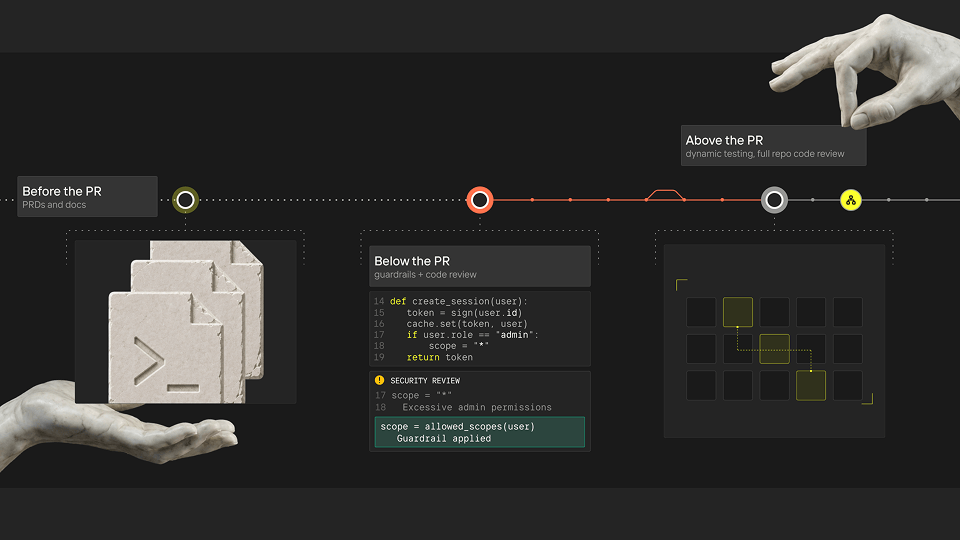
Once you see the PR as a stand-in for attention rather than a control in its own right, the question changes. Scaling review to handle more, bigger PRs is the wrong project. The real question is where that attention needs to live now that it can't all sit in one checkpoint.
Some of it belongs below the PR, where an agent makes decisions in real time and context can be applied before a diff exists. Some belongs above it, at the repository level, because a vulnerability spread across several small, reasonable PRs never shows up in any single diff. And some belongs before the PR entirely, in the architecture and design decisions that shape what an agent, or a developer, can build in the first place.
The repository level is the one that should give people pause, because the industry has been there before. Repo-wide analysis is where this story started, and it collapsed under its own findings. But that was a context problem, not a level problem. The tools flagged patterns without knowing what was reachable, what was exploitable, or what mattered to the product. Analysis that traces attack vectors and validates exploitability before it surfaces anything produces the one thing the old scanners never could: a short list. Five findings a developer will actually fix, with a risk score that is attached to a product. The comment-count condition, restored at the level the industry abandoned.
So PR reviews are dead? Right? Right?
No, PR reviews aren't dead. The pause they measured is.
Reviews stay in the program as one place security happens, not the primary one. Attention has to live where decisions live now: in the design before code exists, in the code as it's written, in the repository as it evolves. This is what we do at Prime, that's the architecture: review the design, guard the code, trace attack vectors across the repo, dependencies, and cloud continuously.