Prime Resources
featured articles

Cutting Through ProdSec Noise
Prioritizing Vulnerabilities by Context Driven Attack Paths, Not Severity Score
Open any vulnerability dashboard right now and you'll see the same thing every security team sees: more findings than anyone could review in a lifetime, ranked by severity scores that all cluster near the top. Roughly 48,000 new CVEs were published in 2025 alone, and the average program has bandwidth to remediate somewhere between 10 and 15 percent of its backlog in a given month. That gap between what gets found and what gets fixed isn't a staffing problem. It's noise, and it's been mistaken for a risk picture for long enough that most teams have stopped questioning it.
Vendors have started layering exploitability and reachability signals on top of severity scores, flagging whether a CVE has a known exploit in the wild or whether the vulnerable function is actually called by application code. That's a real step past CVSS alone, and it does cut some findings out of the queue. But exploitability and reachability answer "can this be exploited," not "does it matter here." A reachable, exploitable vulnerability in an internal tool with no sensitive data behind it is a different risk than the identical vulnerability in a service with a direct path to payment data, and exploitability scoring alone can't tell those two apart. Without the business and architectural context to make that distinction, exploitability and reachability data just re-sorts the same pile into a slightly different order. It doesn't reduce it.
Where All This Noise Comes From
Noise doesn't come from one bad scanner. It comes from the fact that every scanner you add reports its own findings in isolation, with no view of whether anything it flags actually connects to anything else. SAST grades code. SCA grades dependencies. Secret scanning grades commits. Each one is doing its job correctly, and each one is contributing its own independent stream of severity-ranked findings to a backlog that was already too large before it showed up.
That fragmentation was survivable when code shipped at human pace. AI coding agents have removed that constraint, and the backlog is growing with it. A developer opens a handful of pull requests a day; an agent working in the background can open dozens, and every one of them triggers its own pass from every scanner in the pipeline. The noise problem stopped being something a team could plan around once a quarter and became something that compounds with every commit an agent makes, which means the case for reducing it is no longer theoretical. It's urgent, and it gets more urgent by the day.
Adding tools to cover more of the stack feels like progress, and in a narrow sense it is. But it also means the noise compounds. Four scanners each reporting cleanly on their own slice of the product doesn't add up to a quieter picture of risk. It adds up to four separate streams of findings, none of which know about the other three, and that isolation is exactly what produces false positives and false confidence in the same breath. A scanner with no view of the environment has no way to know a downstream control already neutralizes what it just flagged, so it reports a real finding as urgent when it isn't. The opposite failure is just as common: without understanding how the surrounding system actually behaves, a tool can't verify whether a vulnerability it found is reachable in an actual attack path, which means genuine risk gets buried in the same pile as the noise around it.
Why More Noise Doesn't Mean More Security
The instinct is to sort the noise by severity and work top-down. That fails because severity measures how bad a vulnerability could theoretically be, not whether it's reachable, exposed, or exploitable in this specific environment. Two findings with identical CVSS scores can carry completely different risk depending on what's around them: one sits behind three layers of controls, the other has a direct path to production. A backlog sorted by severity alone treats those as the same problem, which is exactly why teams burn remediation capacity on findings that were never going anywhere while genuinely dangerous ones sit untouched further down the list.
Cutting Through the Noise Starts with One Question
Cutting through that noise isn't a matter of triaging faster or tuning the scoring model harder. It requires asking a different question of every finding, one severity scores were never built to answer: is this part of a path an attacker could actually walk right now, given what it connects to. And more importantly, how feasible is this path? If an exploit requires Tom Cruise to dangle dramatically from the ceiling, it’s unlikely to be prioritized by attackers. In other words, there is no simple solution that relies on a single score…which is exactly why context matters!
That's an execution-path question, not a severity question, and it changes what "important" means. A CVSS 9.8 sitting on a service with no route to anything sensitive isn't urgent, whatever the score says. A medium-severity finding sitting on a component that connects straight to a trust boundary might be the most important thing in the backlog. Severity describes a finding in isolation. An execution path describes what happens once you stop looking at scores and start focusing on the real impact to the business and how exposed the vertical to that impact.
What's Left When You Filter for Execution Paths
Run that filter honestly and the backlog doesn't just get shorter, it changes shape entirely. What's left isn't a smaller version of the same list sorted the same way. It's a small, specific set of findings that are reachable and chained together into something an attacker could actually use, the kind of path where a component that passes its own scan cleanly still turns out to be one link in a route to something that matters.
Building a Practice Around Signal, Not Volume
None of this is an argument for buying another scanner. Another scanner adds another stream of severity-ranked findings, which is exactly the problem, not the fix. What's needed is something that doesn't produce its own isolated list at all: a way of seeing the product as one connected system, where a finding is judged by what it opens up rather than scored and filed on its own.
SAST, SCA, and secret scanning were built to grade their own slice of the product well, not to reason across slices, and no amount of tuning changes that. What's missing is a layer above all of them, one that holds architecture, data flows, and access paths in view together and asks the question none of the individual scanners can: does this finding sit on a path an attacker could really walk, given everything else true about this product right now.
The Elephant in the Room: Developer Alert Fatigue
The noise problem doesn't stay in security's backlog. Every finding that reaches a developer without context asks them to stop and chase down whether it's real, and often it isn't: a downstream control already handles it, the path doesn't exist, the function isn't even called. After enough of those empty chases, the rational response isn't more diligence. It's discounting the next finding, and the one after that.
That erosion is the real cost. It isn't just inefficient for security teams triaging a backlog. It teaches developers, correctly, that most of what lands in their queue isn't worth their time, which means the findings that actually matter now have to fight through that learned skepticism to get acted on at all. The fix isn't more findings or sterner tickets. It's surfacing only what's already been checked against the path it would need to travel.
What This Means for Security Leaders
The measure of a good vulnerability management practice was never how many findings you closed this quarter. It's whether what's left in front of your team, after the noise is filtered out, is actually worth their time. A shorter list sorted by the same broken signal isn't progress. A list built from real execution paths, however short, is.
At Prime, this is the case for correlating findings against real execution paths across the whole product rather than triaging them one severity score at a time, so what reaches your team is what an attacker could actually walk, not everything a scanner happened to flag.
Ready to see what's left once the noise is filtered out? Learn more at primesec.ai.

Software Security Needs a New Unit to Review
For the last decade, the pull request has been the moment a developer's work paused long enough for someone else to look at it. That pause is what turned the PR into a checkpoint. A reviewer read the diff and checked it for whatever could go wrong: bugs, broken business logic, security holes. Nobody designed the PR to be a security control. It became one because it was the last place in the software lifecycle where a person reliably paid attention before code shipped.
Now agentic development is breaking the math that made the diff work. PRs are getting bigger and more frequent at the same time, and the pause they run through hasn't gotten any longer. The unit of review is shifting under security's feet.
Before anyone scanned PRs, security tools ran against whole repositories, and compliance programs accepted that as review. The results were unusable: thousands of noisy findings and no way to tell which ones mattered. So the industry moved down to the diff. It was the easiest unit to work with, not the right one.
The PR is changing. Drastically.
Look at what a pull request is actually made of: a diff, a comment thread, and an approval button. None of it was ever the control. It was just tooling built for the moment someone paused to review the work. The pause survived on three conditions. PRs stayed small enough to read closely. Rare enough that every one of them got read. And the review produced a handful of issues that a developer will actually fix.
Agentic development is killing all three at once. Cursor's enterprise data shows average PR size more than doubling, with volume up another 25% on top. Mega PRs, 1,000 lines or more, are now routine. A Microsoft study of Claude Code and GitHub Copilot CLI users found adopters merging roughly 24% more PRs, hitting 50% in heavy-use weeks and holding there for four months. And bigger PRs carry more issues per review, pushing every comment thread past the point where developers stop reading it.
Any one of these would strain a review built around a careful pause. Together they take away everything it needed: time per PR, few enough PRs to give each one that time, and findings scarce enough to get fixed.
What's actually inside all those new PRs
Volume is only half the problem. The other half is what's landing inside each PR. CodeRabbit's analysis of AI-co-authored pull requests found they carry roughly 1.7 times more issues than human-only PRs, including 1.5 to 2 times more security-relevant findings like improper credential handling and insecure object references. High-issue outliers cluster in AI-assisted work. So a reviewer doesn't know which PR needed the slow read until they've already skimmed past it.
Compliance programs accept PR approvals as evidence that changes were reviewed before deployment. Today, the audit trail looks exactly like it did three years ago. What's changed is what that approval means. It used to mean someone read the code. Now, on a 1,500-line agent-written PR that arrived with six others that morning, it mostly means the person ran out of reasons to keep it open. The requirement is still being met on paper. Whether real security is happening underneath is a separate question, and no audit is built to ask it.
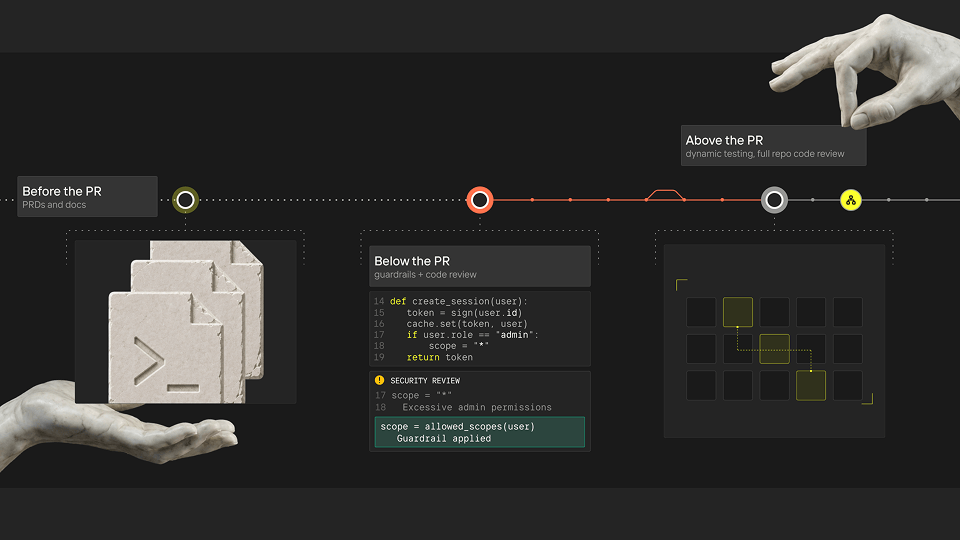
The unit was always a proxy
Once you see the PR as a stand-in for attention rather than a control in its own right, the question changes. Scaling review to handle more, bigger PRs is the wrong project. The real question is where that attention needs to live now that it can't all sit in one checkpoint.
Some of it belongs below the PR, where an agent makes decisions in real time and context can be applied before a diff exists. Some belongs above it, at the repository level, because a vulnerability spread across several small, reasonable PRs never shows up in any single diff. And some belongs before the PR entirely, in the architecture and design decisions that shape what an agent, or a developer, can build in the first place.
The repository level is the one that should give people pause, because the industry has been there before. Repo-wide analysis is where this story started, and it collapsed under its own findings. But that was a context problem, not a level problem. The tools flagged patterns without knowing what was reachable, what was exploitable, or what mattered to the product. Analysis that traces attack vectors and validates exploitability before it surfaces anything produces the one thing the old scanners never could: a short list. Five findings a developer will actually fix, with a risk score that is attached to a product. The comment-count condition, restored at the level the industry abandoned.
So PR reviews are dead? Right? Right?
No, PR reviews aren't dead. The pause they measured is.
Reviews stay in the program as one place security happens, not the primary one. Attention has to live where decisions live now: in the design before code exists, in the code as it's written, in the repository as it evolves. This is what we do at Prime, that's the architecture: review the design, guard the code, trace attack vectors across the repo, dependencies, and cloud continuously.

Black-Box Pentesting Gives Attackers the Advantage
For years, black-box penetration testing has relied on a simple premise: simulate an attacker who knows nothing about the system. The tester starts outside the application, discovers endpoints and functionality, infers architecture, and gradually builds an understanding of how the product works.
That assumption is outdated.
A serious attacker already has more information than the traditional black-box model assumes. Source code routinely leaves organizations through compromised insiders, contractors, repositories, legitimate access obtained under false pretenses, and AI-assisted development workflows. Source secrecy is no longer a strong foundation for offensive security.
If applications need to remain secure when an adversary understands how they work, testing needs to begin from the same vantage point. That is attacker parity.
Source code leaves through ordinary access
Source-code theft does not require a dramatic breach.
The North Korean IT worker campaign illustrates the problem. The FBI has warned that DPRK IT workers use false identities to obtain legitimate employment with U.S. companies and then use that access to steal proprietary information. In January 2025, the FBI specifically warned that workers had held stolen source code and other proprietary data for ransom.
Google Threat Intelligence has documented the same campaign at significant scale. The important security lesson is how access is obtained. An attacker hired under a false identity receives credentials, repository access, internal communications, and the same development environment as other employees. From the application's perspective, that access is legitimate.
AI-assisted development creates another path. Developers now work across coding assistants, model APIs, IDE extensions, autonomous agents, and third-party development services. When proprietary code is submitted to an external AI service, that service becomes part of the system trusted with the code. NIST's Generative AI Profile identifies data privacy, information security, third-party components, and data governance as areas organizations need to manage when deploying generative AI.
Source confidentiality is a weak assumption for an offensive security strategy.
Black-box testing assumes attacker ignorance
A black-box tester spends part of every engagement reconstructing information the engineering organization already possesses. They discover APIs, map routes, infer trust boundaries, experiment with authentication flows, and probe application behavior to understand the architecture.
That work is useful when the objective is to measure what an outsider discovers from an exposed application. It is a limited model of what a capable adversary does.
Source access changes the economics of attacking an application. Reconnaissance is faster, hypotheses are easier to form, and security controls are inspected directly instead of inferred through trial and error. Authorization logic, hidden endpoints, dependency behavior, and implementation assumptions all become easier to investigate.
The attacker spends more time searching for exploitable weaknesses while the black-box tester spends valuable engagement time rediscovering how the product works.
We already accept this model with open-source software. Security controls in an open-source application must withstand attackers who can inspect the implementation. Proprietary applications deserve the same standard.
White-box testing creates attacker parity
Defenders already possess an extraordinary amount of useful security context. They have the source code, architecture, security requirements, dependencies, deployment model, and historical design decisions.
White-box penetration testing puts that context to work.
A tester who understands the implementation moves directly into deeper questions about exploitability. They trace authorization logic across services, follow data through trust boundaries, examine how security controls are implemented, and identify places where implementation differs from design intent.
That context also makes it easier to investigate attack paths rather than isolated findings. A minor authorization weakness becomes critical when combined with a particular identity path or cloud configuration. Source code provides only part of that picture. Effective Product Security testing also needs architectural context, identity, infrastructure, dependencies, and application behavior.
A capable attacker uses whatever information they obtain. Defenders should use the information they already own.
Attacker parity must continue as the product changes
A white-box assessment still represents a point in time. The application starts changing again as soon as the engagement ends.
New code lands, dependencies change, APIs evolve, infrastructure is modified, and authorization logic gets refactored. AI coding tools and development agents have accelerated software production and increased the volume of changes security teams need to understand.
Attackers keep studying the product as it evolves. Offensive security needs the same continuity.
Continuous white-box pentesting preserves application context and repeatedly evaluates what is actually exploitable as the product changes. At Prime, that means connecting code with architecture, dependencies, cloud resources, application behavior, security decisions, and attack paths so testing starts with the context required to investigate meaningful risk.
Black-box testing still has a role
Black-box testing remains useful for understanding what an unauthenticated or opportunistic outsider discovers. It tests externally observable attack surface and exposes weaknesses in authentication, configuration, discovery, and application behavior.
It should not define the upper bound of an offensive security program.
A motivated adversary has source code, internal documentation, credentials, architecture details, or extensive time to study how the product works. Your security team already has more context than that.
Use it.
Treat source access as part of the threat model, give testers the information advantage available to defenders, and test applications from the perspective of an informed adversary.
Ready to see how Prime continuously tests applications with the same product context an informed attacker would? Learn more at primesec.ai.
Cutting Through ProdSec Noise
Prioritizing Vulnerabilities by Context Driven Attack Paths, Not Severity Score
Open any vulnerability dashboard right now and you'll see the same thing every security team sees: more findings than anyone could review in a lifetime, ranked by severity scores that all cluster near the top. Roughly 48,000 new CVEs were published in 2025 alone, and the average program has bandwidth to remediate somewhere between 10 and 15 percent of its backlog in a given month. That gap between what gets found and what gets fixed isn't a staffing problem. It's noise, and it's been mistaken for a risk picture for long enough that most teams have stopped questioning it.
Vendors have started layering exploitability and reachability signals on top of severity scores, flagging whether a CVE has a known exploit in the wild or whether the vulnerable function is actually called by application code. That's a real step past CVSS alone, and it does cut some findings out of the queue. But exploitability and reachability answer "can this be exploited," not "does it matter here." A reachable, exploitable vulnerability in an internal tool with no sensitive data behind it is a different risk than the identical vulnerability in a service with a direct path to payment data, and exploitability scoring alone can't tell those two apart. Without the business and architectural context to make that distinction, exploitability and reachability data just re-sorts the same pile into a slightly different order. It doesn't reduce it.
Where All This Noise Comes From
Noise doesn't come from one bad scanner. It comes from the fact that every scanner you add reports its own findings in isolation, with no view of whether anything it flags actually connects to anything else. SAST grades code. SCA grades dependencies. Secret scanning grades commits. Each one is doing its job correctly, and each one is contributing its own independent stream of severity-ranked findings to a backlog that was already too large before it showed up.
That fragmentation was survivable when code shipped at human pace. AI coding agents have removed that constraint, and the backlog is growing with it. A developer opens a handful of pull requests a day; an agent working in the background can open dozens, and every one of them triggers its own pass from every scanner in the pipeline. The noise problem stopped being something a team could plan around once a quarter and became something that compounds with every commit an agent makes, which means the case for reducing it is no longer theoretical. It's urgent, and it gets more urgent by the day.
Adding tools to cover more of the stack feels like progress, and in a narrow sense it is. But it also means the noise compounds. Four scanners each reporting cleanly on their own slice of the product doesn't add up to a quieter picture of risk. It adds up to four separate streams of findings, none of which know about the other three, and that isolation is exactly what produces false positives and false confidence in the same breath. A scanner with no view of the environment has no way to know a downstream control already neutralizes what it just flagged, so it reports a real finding as urgent when it isn't. The opposite failure is just as common: without understanding how the surrounding system actually behaves, a tool can't verify whether a vulnerability it found is reachable in an actual attack path, which means genuine risk gets buried in the same pile as the noise around it.
Why More Noise Doesn't Mean More Security
The instinct is to sort the noise by severity and work top-down. That fails because severity measures how bad a vulnerability could theoretically be, not whether it's reachable, exposed, or exploitable in this specific environment. Two findings with identical CVSS scores can carry completely different risk depending on what's around them: one sits behind three layers of controls, the other has a direct path to production. A backlog sorted by severity alone treats those as the same problem, which is exactly why teams burn remediation capacity on findings that were never going anywhere while genuinely dangerous ones sit untouched further down the list.
Cutting Through the Noise Starts with One Question
Cutting through that noise isn't a matter of triaging faster or tuning the scoring model harder. It requires asking a different question of every finding, one severity scores were never built to answer: is this part of a path an attacker could actually walk right now, given what it connects to. And more importantly, how feasible is this path? If an exploit requires Tom Cruise to dangle dramatically from the ceiling, it’s unlikely to be prioritized by attackers. In other words, there is no simple solution that relies on a single score…which is exactly why context matters!
That's an execution-path question, not a severity question, and it changes what "important" means. A CVSS 9.8 sitting on a service with no route to anything sensitive isn't urgent, whatever the score says. A medium-severity finding sitting on a component that connects straight to a trust boundary might be the most important thing in the backlog. Severity describes a finding in isolation. An execution path describes what happens once you stop looking at scores and start focusing on the real impact to the business and how exposed the vertical to that impact.
What's Left When You Filter for Execution Paths
Run that filter honestly and the backlog doesn't just get shorter, it changes shape entirely. What's left isn't a smaller version of the same list sorted the same way. It's a small, specific set of findings that are reachable and chained together into something an attacker could actually use, the kind of path where a component that passes its own scan cleanly still turns out to be one link in a route to something that matters.
Building a Practice Around Signal, Not Volume
None of this is an argument for buying another scanner. Another scanner adds another stream of severity-ranked findings, which is exactly the problem, not the fix. What's needed is something that doesn't produce its own isolated list at all: a way of seeing the product as one connected system, where a finding is judged by what it opens up rather than scored and filed on its own.
SAST, SCA, and secret scanning were built to grade their own slice of the product well, not to reason across slices, and no amount of tuning changes that. What's missing is a layer above all of them, one that holds architecture, data flows, and access paths in view together and asks the question none of the individual scanners can: does this finding sit on a path an attacker could really walk, given everything else true about this product right now.
The Elephant in the Room: Developer Alert Fatigue
The noise problem doesn't stay in security's backlog. Every finding that reaches a developer without context asks them to stop and chase down whether it's real, and often it isn't: a downstream control already handles it, the path doesn't exist, the function isn't even called. After enough of those empty chases, the rational response isn't more diligence. It's discounting the next finding, and the one after that.
That erosion is the real cost. It isn't just inefficient for security teams triaging a backlog. It teaches developers, correctly, that most of what lands in their queue isn't worth their time, which means the findings that actually matter now have to fight through that learned skepticism to get acted on at all. The fix isn't more findings or sterner tickets. It's surfacing only what's already been checked against the path it would need to travel.
What This Means for Security Leaders
The measure of a good vulnerability management practice was never how many findings you closed this quarter. It's whether what's left in front of your team, after the noise is filtered out, is actually worth their time. A shorter list sorted by the same broken signal isn't progress. A list built from real execution paths, however short, is.
At Prime, this is the case for correlating findings against real execution paths across the whole product rather than triaging them one severity score at a time, so what reaches your team is what an attacker could actually walk, not everything a scanner happened to flag.
Ready to see what's left once the noise is filtered out? Learn more at primesec.ai.
Software Security Needs a New Unit to Review
For the last decade, the pull request has been the moment a developer's work paused long enough for someone else to look at it. That pause is what turned the PR into a checkpoint. A reviewer read the diff and checked it for whatever could go wrong: bugs, broken business logic, security holes. Nobody designed the PR to be a security control. It became one because it was the last place in the software lifecycle where a person reliably paid attention before code shipped.
Now agentic development is breaking the math that made the diff work. PRs are getting bigger and more frequent at the same time, and the pause they run through hasn't gotten any longer. The unit of review is shifting under security's feet.
Before anyone scanned PRs, security tools ran against whole repositories, and compliance programs accepted that as review. The results were unusable: thousands of noisy findings and no way to tell which ones mattered. So the industry moved down to the diff. It was the easiest unit to work with, not the right one.
The PR is changing. Drastically.
Look at what a pull request is actually made of: a diff, a comment thread, and an approval button. None of it was ever the control. It was just tooling built for the moment someone paused to review the work. The pause survived on three conditions. PRs stayed small enough to read closely. Rare enough that every one of them got read. And the review produced a handful of issues that a developer will actually fix.
Agentic development is killing all three at once. Cursor's enterprise data shows average PR size more than doubling, with volume up another 25% on top. Mega PRs, 1,000 lines or more, are now routine. A Microsoft study of Claude Code and GitHub Copilot CLI users found adopters merging roughly 24% more PRs, hitting 50% in heavy-use weeks and holding there for four months. And bigger PRs carry more issues per review, pushing every comment thread past the point where developers stop reading it.
Any one of these would strain a review built around a careful pause. Together they take away everything it needed: time per PR, few enough PRs to give each one that time, and findings scarce enough to get fixed.
What's actually inside all those new PRs
Volume is only half the problem. The other half is what's landing inside each PR. CodeRabbit's analysis of AI-co-authored pull requests found they carry roughly 1.7 times more issues than human-only PRs, including 1.5 to 2 times more security-relevant findings like improper credential handling and insecure object references. High-issue outliers cluster in AI-assisted work. So a reviewer doesn't know which PR needed the slow read until they've already skimmed past it.
Compliance programs accept PR approvals as evidence that changes were reviewed before deployment. Today, the audit trail looks exactly like it did three years ago. What's changed is what that approval means. It used to mean someone read the code. Now, on a 1,500-line agent-written PR that arrived with six others that morning, it mostly means the person ran out of reasons to keep it open. The requirement is still being met on paper. Whether real security is happening underneath is a separate question, and no audit is built to ask it.
The unit was always a proxy
Once you see the PR as a stand-in for attention rather than a control in its own right, the question changes. Scaling review to handle more, bigger PRs is the wrong project. The real question is where that attention needs to live now that it can't all sit in one checkpoint.
Some of it belongs below the PR, where an agent makes decisions in real time and context can be applied before a diff exists. Some belongs above it, at the repository level, because a vulnerability spread across several small, reasonable PRs never shows up in any single diff. And some belongs before the PR entirely, in the architecture and design decisions that shape what an agent, or a developer, can build in the first place.
The repository level is the one that should give people pause, because the industry has been there before. Repo-wide analysis is where this story started, and it collapsed under its own findings. But that was a context problem, not a level problem. The tools flagged patterns without knowing what was reachable, what was exploitable, or what mattered to the product. Analysis that traces attack vectors and validates exploitability before it surfaces anything produces the one thing the old scanners never could: a short list. Five findings a developer will actually fix, with a risk score that is attached to a product. The comment-count condition, restored at the level the industry abandoned.
So PR reviews are dead? Right? Right?
No, PR reviews aren't dead. The pause they measured is.
Reviews stay in the program as one place security happens, not the primary one. Attention has to live where decisions live now: in the design before code exists, in the code as it's written, in the repository as it evolves. This is what we do at Prime, that's the architecture: review the design, guard the code, trace attack vectors across the repo, dependencies, and cloud continuously.
Black-Box Pentesting Gives Attackers the Advantage
For years, black-box penetration testing has relied on a simple premise: simulate an attacker who knows nothing about the system. The tester starts outside the application, discovers endpoints and functionality, infers architecture, and gradually builds an understanding of how the product works.
That assumption is outdated.
A serious attacker already has more information than the traditional black-box model assumes. Source code routinely leaves organizations through compromised insiders, contractors, repositories, legitimate access obtained under false pretenses, and AI-assisted development workflows. Source secrecy is no longer a strong foundation for offensive security.
If applications need to remain secure when an adversary understands how they work, testing needs to begin from the same vantage point. That is attacker parity.
Source code leaves through ordinary access
Source-code theft does not require a dramatic breach.
The North Korean IT worker campaign illustrates the problem. The FBI has warned that DPRK IT workers use false identities to obtain legitimate employment with U.S. companies and then use that access to steal proprietary information. In January 2025, the FBI specifically warned that workers had held stolen source code and other proprietary data for ransom.
Google Threat Intelligence has documented the same campaign at significant scale. The important security lesson is how access is obtained. An attacker hired under a false identity receives credentials, repository access, internal communications, and the same development environment as other employees. From the application's perspective, that access is legitimate.
AI-assisted development creates another path. Developers now work across coding assistants, model APIs, IDE extensions, autonomous agents, and third-party development services. When proprietary code is submitted to an external AI service, that service becomes part of the system trusted with the code. NIST's Generative AI Profile identifies data privacy, information security, third-party components, and data governance as areas organizations need to manage when deploying generative AI.
Source confidentiality is a weak assumption for an offensive security strategy.
Black-box testing assumes attacker ignorance
A black-box tester spends part of every engagement reconstructing information the engineering organization already possesses. They discover APIs, map routes, infer trust boundaries, experiment with authentication flows, and probe application behavior to understand the architecture.
That work is useful when the objective is to measure what an outsider discovers from an exposed application. It is a limited model of what a capable adversary does.
Source access changes the economics of attacking an application. Reconnaissance is faster, hypotheses are easier to form, and security controls are inspected directly instead of inferred through trial and error. Authorization logic, hidden endpoints, dependency behavior, and implementation assumptions all become easier to investigate.
The attacker spends more time searching for exploitable weaknesses while the black-box tester spends valuable engagement time rediscovering how the product works.
We already accept this model with open-source software. Security controls in an open-source application must withstand attackers who can inspect the implementation. Proprietary applications deserve the same standard.
White-box testing creates attacker parity
Defenders already possess an extraordinary amount of useful security context. They have the source code, architecture, security requirements, dependencies, deployment model, and historical design decisions.
White-box penetration testing puts that context to work.
A tester who understands the implementation moves directly into deeper questions about exploitability. They trace authorization logic across services, follow data through trust boundaries, examine how security controls are implemented, and identify places where implementation differs from design intent.
That context also makes it easier to investigate attack paths rather than isolated findings. A minor authorization weakness becomes critical when combined with a particular identity path or cloud configuration. Source code provides only part of that picture. Effective Product Security testing also needs architectural context, identity, infrastructure, dependencies, and application behavior.
A capable attacker uses whatever information they obtain. Defenders should use the information they already own.
Attacker parity must continue as the product changes
A white-box assessment still represents a point in time. The application starts changing again as soon as the engagement ends.
New code lands, dependencies change, APIs evolve, infrastructure is modified, and authorization logic gets refactored. AI coding tools and development agents have accelerated software production and increased the volume of changes security teams need to understand.
Attackers keep studying the product as it evolves. Offensive security needs the same continuity.
Continuous white-box pentesting preserves application context and repeatedly evaluates what is actually exploitable as the product changes. At Prime, that means connecting code with architecture, dependencies, cloud resources, application behavior, security decisions, and attack paths so testing starts with the context required to investigate meaningful risk.
Black-box testing still has a role
Black-box testing remains useful for understanding what an unauthenticated or opportunistic outsider discovers. It tests externally observable attack surface and exposes weaknesses in authentication, configuration, discovery, and application behavior.
It should not define the upper bound of an offensive security program.
A motivated adversary has source code, internal documentation, credentials, architecture details, or extensive time to study how the product works. Your security team already has more context than that.
Use it.
Treat source access as part of the threat model, give testers the information advantage available to defenders, and test applications from the perspective of an informed adversary.
Ready to see how Prime continuously tests applications with the same product context an informed attacker would? Learn more at primesec.ai.
Prime introduces a new operating model for Product Security
Prime Security today introduced a new operating model for Product Security, expanding its platform to help security teams participate in every product decision - from architecture and design through implementation and continuous validation.
The announcement comes as the company returns to Black Hat USA, one year after winning the conference's prestigious Startup Spotlight competition, where it will showcase the expanded platform this week in Las Vegas.
Prime's expanded platform addresses a fundamental change in how software is built. As AI accelerates engineering and compresses the distance between architecture, implementation, and deployment, security can no longer rely on reviewing finished code alone. It must participate continuously as products are designed, built, and shipped.
From day one, Prime has taken a different approach to Product Security. Rather than analyzing isolated pieces of software, the platform was built to understand products as complete systems - starting with architecture and design decisions, where critical security context is created long before code is written.
That architectural foundation now extends across the entire product lifecycle, enabling security teams to participate before the code, in the code, and after the code through a shared understanding of the product.
The expanded platform includes autonomous design reviews, AI security code reviews, AI coding guardrails, risk-focused software supply chain security, and continuous white-box pentesting - all powered by the same understanding of the product and its architecture.
Prime CEO Michael Nov said:
"Software development has fundamentally changed. Architecture, implementation, and deployment no longer happen as separate phases - they increasingly happen together, often inside the same AI-assisted workflow. Security can't keep up by reviewing software after it's built because the important decisions have already been made. Product Security has to participate as those decisions are being made. That's what Prime was built for."
Backed by Foundation Capital, Flybridge and Scale Venture Partners, Prime is trusted by organizations including PayPal, Bumble, Qualtrics, MX, and ThoughtSpot among its customers.
Customers report completing security design reviews in as little as 15 minutes, increasing security team capacity by 4-5x, and reducing false positives by up to 90% compared to traditional application security approaches.
Learn more at https://www.primesec.ai or visit https://www.primesec.ai/blackhat-2026 for Black Hat activities and event information.

Before the Code. In the Code. After the Code. Security in the age of AI Factories
Software development didn't just get faster. It broke shape. The old shape of plan, design, build, test, deploy is not how software gets built anymore. Now it is specs in one place, prompts in another, code written by humans and agents, architecture decisions made in a chat window, and tests generated after the fact.
The boundary around who builds is dissolving too. Engineers orchestrate agents. Product managers turn ideas into real products with the help of vibe coding. Business Analysts build workflows that touch real data and real systems. Some of it enters the formal SDLC. Some never do. All of it changes the attack surface.
The end state is becoming obvious: software factories run mostly by agents, the way lights-out factories run manufacturing lines with no humans on the floor. Some companies are already there. Most are in the awkward middle - partial adoption, uneven quality, and pressure to move faster anyway.
Strip away the noise and the goal is simple: whatever reaches production has to be secure and follow the rules you set for it. That job did not change. Everything around it did.
Shift left and DevSecOps were the right answers for their moment - but both were designed around developers making decisions. Now agents make architectural choices, wire data flows, and push work forward faster than any human checkpoint can follow. Every prompt, every PR, every agent-generated feature is an architectural decision your security team never reviewed.
The next model is not a faster human. It is an autonomous security agent operating in the same environment as the development agents - and it cannot work component by component. Attackers already don't: AI-powered attack tooling chains the design flaws, code vulnerabilities, and cloud misconfigs your agents just introduced into single exploitable paths. Scanners see files. Pipelines see changes. Attackers see weaknesses - and need only one that connects. Security has to see the product - that is where weaknesses connect: what is being planned, what is in work, and what has shipped.
That is what Product Security means now. Not security embedded in a pipeline - security as an autonomous participant in it, holding the product view through every stage: before the code, in it, and after it.
Before the code - where intent gets set and attack vectors get introduced
For business critical features and complex systems, design still deserves real scrutiny before a single line gets written. An agent factory executing a flawed design quickly is worse than a slow team building the wrong thing manually. The blast radius is bigger. A missing auth requirement, a broken tenant isolation model, an exposed data flow - these are not code problems. They are design decisions, and agents execute them at speed.
As spec-driven development matures, getting the spec right becomes the highest-leverage security investment you can make. The old way of getting it right was threat modeling - a workshop, a whiteboard, an architect asking the right questions. It worked, for the handful of features that got one. That trade dies when a product manager's spec becomes running code in a day. Autonomous review changes the economics: it reads every spec, ticket, and PRD as it is written - wherever intent lives - and asks what the architect would have asked.
What the design stage gives you is the missing context: what the feature is meant to do, who should reach it, what data it touches, and what it must never allow. Without that, the check after the code can only answer one question: is this vulnerable? With it, it can answer the ones that actually drive a decision: does this vulnerability matter, what does it cost the business, and is this what was supposed to get built?
Design is still where security starts. It is no longer where it stops. The review does not produce just a report. It produces the context the next stage runs on.
In the code - security cannot just guide agents. It has to act.
Prompts change. Models change. Agents change. The system is what accumulates - every architecture decision, every trust boundary, every data flow, every intent, layered over years. Without that context, a security agent can reason about code. With it, it can reason about the system.
Security has two jobs here: steer the work while it is written, and gate it before it merges.
Steering happens in the moment. A development agent starts wiring a new data flow - the security agent loads the live architecture, reads the trust boundaries, and if something is wrong, intervenes. Not a flag. Not a ticket. An agent with the authority to block a bad decision before it is ever committed.
The gate is the pull request - the last moment a change is still just a proposed change. Everything gets checked, every time, no matter who or what wrote the code. The gate answers one question: does this change violate a rule you already set? Hardcoded secrets, broken cryptography, and prohibited patterns do not require system-wide reasoning. They are known violations and should be stopped immediately. That is what makes the gate fast, deterministic, and difficult to argue with. Exploitability is a different question.
The PR merges. The change becomes part of the system. And exploitability lives in the system, not the diff.
After the code - where exploitable paths get validated
The change has landed. It is part of a system now. Whether it is exploitable is no longer a fact about the change - it is a fact about the system around it. The gate answered one question: did you break a rule. This stage answers the other: is there a path to exploit. The analysis starts the moment the change lands, before anything ships, and it never stops after.
First, at the repo level. A flagged line of code matters only if it plays a part in an attack path - as the way in, or as a step along the way - past the controls that exist. A vulnerable dependency only matters if the vulnerable function is reachable and exploitable with input an attacker controls. Part of no path is noise. That is how the 200-issue queue dies - validation eliminates the 195 that never mattered and confirms the five that did.
Then at the system level, continuously. Clean when it landed does not mean clean today: a new CVE drops against a dependency you merged six months ago, a cloud config drifts, another team's change opens a path through your service. The attacker does not care which PR introduced which piece - only whether a path exists through the system as it runs right now.
You hold the source, the architecture, the cloud controls, and the intent behind every feature - everything an attacker wishes they had, and you have it first. Run the real thing from the inside: continuous, white-box attack path analysis across the live system. An internal service skips authentication because nothing external can reach it. An agent builds on its API, a routing change exposes it - zero findings, one path to customer data. Only the intent recorded on day one makes the last change light up.
Not is this vulnerable - a scanner guesses at that. Is there an exploitable path, through this architecture, past these controls, into this data. You do not infer it. You validate it. The output is not a list of findings. It is a path an attacker can take, end to end.
–
The challenge has shifted. It is no longer "How do we find bugs earlier?" It is "How do we release secure software when the decisions that matter are made autonomously, continuously, and faster than any human review can follow?" That question does not have a checkpoint answer. Security cannot review decisions after they are made. It has to participate in them as they happen.
And participation is not three products at three checkpoints. It is one view of the product - planned, in work, shipped. The intent understood before the code is what makes steering possible during it, and what makes validation credible after it. Break that chain into point tools and each sees a slice; the exploitable path that matters often spans all three. That is not another scanner or another policy engine. It is a new operating model for Product Security.
We built Prime to run that model.
Before the code, it reviews design intent autonomously and records what every feature is supposed to do. In the code, it steers agents and developers with the live architecture loaded, and gates every PR on the rules you set. After the code, it validates exploitable paths continuously across the live system.
This only works as one platform. Prime can validate an exploitable path because it understood what the feature was supposed to do before the code existed, followed how it was implemented, and sees how the system and its controls connect today. That context cannot be reconstructed reliably after the fact. It has to persist from intent through implementation.
The factory is already running. Security can review its decisions after they happen, or participate in them as they are made. We built Prime for the second answer. Before the code. In the code. After the code.

The Most Ignored Artifact in Security is Now the Most Important One
Security policies were the documents nobody read. Written, published, forgotten. Developers worked around them. Security teams rewrote them every two years and called it progress. Everyone understood the game and nobody said anything because it was mostly harmless. A bad policy sat in a wiki somewhere and collected dust.
That is no longer the situation.
In an agentic world the agent does not work around the policy. It follows it. Every time. No judgment, no improvisation, no common sense filling the gaps. That changes what a bad policy costs, in a way most security teams have not fully sat with yet.
A bad policy written for humans is a document nobody reads. Mostly harmless because humans ignored it anyway. A bad policy followed by agents is consistent wrong behavior, at scale, across everything your agents touch. It does not sit in a document anymore. It ships.
Here is what that looks like in practice. A policy that says "use appropriate encryption" is standard language in half the security documents written in the last decade. It tells a human to think and make a reasonable call. It tells an agent to decide. It will decide. It might pick MD5. It will be consistent about it.
The language that felt precise enough for a human audience, "appropriate," "reasonable," "where possible," is not precise at all. It is an instruction to exercise judgment. Rewriting policies for agents forces decisions that security teams have been deferring for years. What does appropriate encryption actually mean in this system? What counts as sensitive data in this context? What should the agent never do, regardless of what it is asked? These questions used to live in someone's head. Now they have to be written down in a form a machine can execute without a human in the loop to catch the edge cases.
The difference in practice looks something like this. The old version says "use appropriate encryption for sensitive data." The new version says "all data classified as sensitive must be encrypted using AES-256-GCM at rest and TLS 1.3 in transit. The agent must not proceed if either condition cannot be verified." One requires a judgment call. The other does not. If you cannot write a test that verifies the agent followed the policy, the policy is not done.
There is one more thing the static policy model never had to confront. The threat landscape does not wait. When a new attack technique gets published, the window between disclosure and active exploitation is sometimes days. A policy that was correct last month can be the thing that gets you next month. Human security teams absorbed that kind of change through awareness, the engineer who read the advisory and updated the standard before it mattered. Agents do not read advisories. They follow what they were given. A policy that cannot be updated dynamically and propagated to every agent consuming it in real time is already becoming a liability the moment it is written. Specificity and machine readability make agent-ready policy powerful. They also make it brittle if the update mechanism is not part of the design from the start.
That is a pipeline problem as much as a content problem. The policy layer has to be live. Version controlled, continuously updated against the current threat landscape, and connected to the agents consuming it in a way that does not require a manual deployment every time something changes. That is new infrastructure most security teams do not have yet and are not building.
That is usually how it goes right before something forces it.
Do it before the agent does something your policy technically allowed.

Preparing Security for the Day of Zero-Touch Development
The security industry has spent three years moving the line.
Code completion would not work, then it did. AI-generated features were off the table, too much state, too much domain knowledge, until that ceiling moved too. At some point this stops being analysis and starts being denial. Full application generation is not a question of if.
To be fair, security people are trained skeptics. Questioning things that seem too easy is the job, and that instinct is usually right. The problem is that the same quality that makes a good security professional, a deep distrust of anything that looks too clean, made this genuinely hard to see coming. The reflex was correct. The situation was just different this time. It happens.
So the question now is whether security is ready. The honest answer is no, and the reason is not what most people assume.
Security was not just built around humans. It was built around human behavior. The invisible judgment calls that happen between a design review and a code review. The developer who remembers what got flagged last sprint. The architect who quietly connects a vulnerability report to the decision that caused it six months earlier. None of that is written down anywhere. It lives in people's heads, and it has for years, because it worked well enough. In most organizations there is a senior engineer who every payments-related finding gets quietly routed to before triage, not because any process says so, but because she is the only one who remembers why a particular call was made in 2019 and what breaks if you touch it. That knowledge is not in any system. It is in her calendar.
Zero-touch development removes those people before most security programs have captured what they know. A dev agent can carry security context, if that context exists somewhere it can reach. The risk is not that agents are blind by nature. It is that most security guidance today is not documented in any form an agent can consume. It is institutional knowledge inside humans who are about to be removed from the loop.
The tools are not too slow. They are islands, and the human who connected them is leaving.
This is the work that has to start now. Not procuring new platforms. Capturing what security teams already know and putting it somewhere agents can actually reach, policy encoded in the pipeline, threat models that live in the repo, guardrail rules derived from the organization's own findings rather than generic frameworks. The difference between an agent that ships secure code and one that does not is almost never the model. It is whether the guidance was there in the first place.
MCP changes something more fundamental than integration. APIs existed before and teams built connectors, but every connection was a custom project, owned by someone, maintained by someone, and when that someone left it quietly broke. MCP makes the connectivity layer a shared standard rather than a collection of bespoke plumbing, so the loop stays closed without a human constantly holding it together. But the architecture is only as good as what goes into it. Connectivity does not fix a documentation problem. Those are two different problems and it is worth being clear about which one you are solving.
The policy layer behind all of this cannot sit in AppSec alone. AppSec owns the enforcement and the enablement, the guardrails, the pipeline controls, the agent-level guidance. But the policy itself has to be built across security, engineering and GRC together. That is not a coordination challenge to be managed. That is the actual work.
The window is open right now. Once zero-touch development is fully running, retrofitting security guidance into a process already operating without it is slower, more expensive and always one step behind. The teams doing this work today are not just getting ahead of a trend. They are building the institutional memory their agents will run on.
The ones waiting are not just behind. They are losing the people who know the things that cannot be recovered.

Most Developers Will Not Understand Security in 5 Years
Developers are already shipping code they didn't write and couldn't fully explain. They described what they wanted and an agent built it. That's not a criticism, it's just the next abstraction layer, same as every one before it. Assembly to C. C to Python. Python to "hey Claude, build me this feature."
Each time we abstract, we gain speed and lose depth. That is the tradeoff. Nobody complains that developers do not write assembly anymore.
But here is the thing nobody in security wants to say: if a developer does not really understand how the code works, they definitely do not understand how secure it is. And we are all kind of tiptoeing around that.
The old DevSecOps model was already barely holding. Developers would write the code, security would run a scanner, get a report that says "SQL injection, line 84," and try to get the developer who wrote line 84 to go fix it while praying that the finding is relevant. It was clunky and slow but it worked because there was a human who had context.
What happens when a human is not the one who wrote line 84? When the diff is 3,000 lines and it came from an agent interpreting a Jira ticket?
Throwing a CVE report at the developer guiding the agent is almost a joke. They don't know what the agent was thinking. Neither do you. And that is in the easy case of a SAST or dependency finding - what if the risk is a chain of lows across multiple repos, or an architectural flaw? This is bound to fail.
This doesn’t mean security goes away, it just has to find a new home in this process.
It is not the developer who needs to know security anymore. It is the agent. Security teams have to get in front of it at the design stage, defining what the agent should do and how it should do it according to how the organization actually works. Then enforce that during the build with guardrails - think prompt-level policy enforcement, tool-call allow-listing, and output scanning - that keep the agent on track in real time. And then test. Nobody is ready to let agents just run unsupervised, compliance won't allow it and, honestly, common sense won't either. Testing is how security teams verify that none of that went wrong. No vulnerabilities, no compliance gaps, no drift from the guidance the agent was given.
Which means the full process looks pretty familiar: guide the agent upfront, give it secure guardrails, test the output. Same thing security teams tried to do with developers for twenty years. Except developers argued back. Agents do not.
There is a consequence to that nobody is talking about yet. Every security and compliance framework assumes you can trace a decision back to a person. When something ships with a vulnerability today there is a chain: who wrote it, who reviewed it, who approved it. When an agent wrote it, that chain dissolves. The agent does not remember its reasoning. The developer did not write the code. Everyone was involved and nobody is accountable. That means the audit trail has to move from people to systems. Agent actions logged, decisions traceable, guidance on record. Not for compliance theater. Because when something goes wrong that record is the only chain left.
And the guidance has to be right. If the security context the agent receives is wrong or incomplete, it will faithfully reproduce the flaw at scale, across every repo, every feature, every team using that agent. That is not a lower bar than the old model. It is a considerably higher one.
Security teams that get this have a real opportunity right now. Not to slow things down, that ship has sailed, but to finally be at the table when the rules get written. The business is moving to agents whether security is ready or not. The only question is whether security shapes how those agents are built, or spends the next decade cleaning up after them.

Tools to Detect Security Risks Across the Entire SDLC: A Deep Dive
Why SDLC Security Coverage Remains a Hard Problem
Design Flaws
The traditional approach to application security focused on testing code after it was written. Static Application Security Testing (SAST) scans source code. Dynamic Application Security Testing (DAST) probes running applications. Software Composition Analysis (SCA) checks dependencies. These tools matter, but they all share a limitation: they find problems after the architecture decisions are already locked in.
Consider a feature that stores sensitive health data in a new microservice. If the team chose the wrong encryption approach, picked an insecure communication protocol, or failed to consider data residency requirements, no amount of code scanning will fix those architectural flaws cheaply. The cost of fixing security issues increases exponentially as you move from design to development to production. A threat identified during design review might take an hour to address. The same threat found in production could require weeks of rework.
The Velocity Problem
Modern engineering teams operate on continuous delivery models. Even without agentic coding, a mid-sized company with 500 developers might still push hundreds of changes per week across dozens of services. Each change carries potential security implications. The math doesn't work for manual review — only high-visibility features get reviewed. Security teams triage constantly, hoping they catch the most dangerous changes while smaller modifications slip through unexamined.
The AI Code Generation Acceleration
Today, tools like GitHub Copilot and Cursor have changed the equation again. Developers now generate code faster than ever. A function that took 30 minutes to write now takes 5 minutes with AI assistance. But AI coding assistants don't inherently understand your organization's security requirements, compliance obligations, or architectural standards. They produce functional code that may or may not align with your security posture.
This creates a new attack surface: AI-generated code that works correctly but introduces vulnerabilities because the AI wasn't context-aware. Your payment processing service needs PCI-DSS compliance. Your healthcare application needs HIPAA safeguards. The AI assistant doesn't know that unless you tell it, and developers often don't think to specify security requirements in their prompts.
Mapping Security Tools to SDLC Phases
| SDLC Phase | Tool Category | Open Source Options | Commercial Options |
|---|---|---|---|
| Requirements & Design | Threat Modeling / Design Review | OWASP Threat Dragon | IriusRisk, Prime Security, ThreatModeler |
| Development | IDE Security Plugins | SonarLint (free tier) | Checkmarx plugins, Prime Security, Snyk IDE |
| Build – SAST | Static Analysis | Semgrep, SonarQube Community | Checkmarx, Fortify, Prime Security, Veracode |
| Build – SCA | Dependency Scanning | OWASP Dependency-Check, Dependabot | Snyk, Mend, Black Duck |
| Build – Secrets | Secrets Detection | GitLeaks, TruffleHog | GitHub Advanced Security |
| Build – IaC | Infrastructure Scanning | Checkov, tfsec, Trivy | Bridgecrew, Snyk IaC |
| Test | Dynamic Testing | OWASP ZAP | Burp Suite, Invicti, Aikido Security |
| Deploy | Container Security | Trivy, Clair | Aqua Security, Sysdig |
| Runtime | Runtime Protection | Falco | Contrast Security, Aqua Security |
| Aggregation | ASPM | DefectDojo | Legit Security, Apiiro, ArmorCode |
Design-Stage Security: Where Most Organizations Fail
Design-stage security review catches architectural flaws before they become expensive problems. Threat modeling, security architecture review, and risk analysis all happen here. Yet this phase receives the least tooling investment in most organizations.
The Manual Threat Modeling Bottleneck
Traditional threat modeling follows a process like STRIDE (Spoofing, Tampering, Repudiation, Information Disclosure, Denial of Service, Elevation of Privilege) or PASTA (Process for Attack Simulation and Threat Analysis). A security architect reviews system diagrams, identifies assets and trust boundaries, brainstorms potential threats, and documents mitigations.
This works well for large, well-defined projects with clear timelines. It fails for agile development where requirements evolve weekly and features ship in two-week sprints. By the time a manual threat model is complete, the architecture may have already changed.
Gen 1 Threat Modeling Tools: Diagram-Centric Approaches
First-generation threat modeling platforms like ThreatModeler, IriusRisk, and SD Elements attempted to speed up manual processes. They provide structured workflows for creating data flow diagrams, identifying threats based on component types, and generating security requirements.
These tools improved consistency and documentation. A threat model created in IriusRisk follows a predictable format and covers standard threat categories. But they still require significant manual effort:
- Someone must create or update the system diagrams
- Security architects must interpret results and prioritize findings
- Integration with development workflows remains limited
- No automatic scanning of planned work in Jira or other ALM tools
IriusRisk describes itself as an automated threat modeling platform that helps identify and mitigate security risks early in the SDLC based on system architecture diagrams and questionnaires. The key phrase is "based on diagrams and questionnaires." If nobody creates the diagram or fills out the questionnaire, no analysis happens.
AI-Native Design Review: The Next Generation
A newer category of tools uses AI to automate design-stage security analysis. Instead of waiting for manual diagram creation, these platforms scan development planning tools (Jira, Confluence, Azure DevOps, Linear) to identify security-relevant work automatically.
The approach works like this:
- Continuous scanning: The platform monitors your ALM tools for new epics, stories, and design documents
- Context discovery: AI analyzes PRDs, ERDs, architecture docs, and related artifacts to understand what's being built
- Risk identification: The system identifies potential security risks based on the planned changes
- Automated analysis: AI generates threat analysis, data flow diagrams, and mitigation recommendations
- Workflow integration: Findings appear in developer tools, not separate security portals
This shifts the model from "security must initiate reviews" to "reviews happen automatically for all planned work." Coverage expands from 10-15% to nearly 100% of development activity.
What separates mature AI-native platforms from earlier entrants in this category is what happens across reviews over time. The most capable platforms maintain an AI memory layer — accumulating past reviews, approved architectural patterns, policy resolutions, and design decisions — and apply that institutional knowledge automatically to new work. A risk that was assessed and mitigated six months ago informs how a similar design is evaluated today. That compounding organizational context is what distinguishes a platform that gets smarter over time from one that simply automates a static checklist.
Static Analysis Tools: Finding Bugs in Source Code
Static Application Security Testing (SAST) analyzes source code without executing it. These tools look for patterns that indicate vulnerabilities: SQL injection, cross-site scripting, buffer overflows, insecure cryptography, and hundreds of other issue types.
Leading SAST Platforms:
- Checkmarx: Enterprise SAST, 25+ programming languages, integrates with major CI/CD systems
- SonarQube: Code quality and security analysis; open-source Community Edition plus commercial tiers
- Semgrep: Lightweight, pattern-based scanning with YAML rule format; fast enough for pre-commit hooks
SAST Limitations:
- False positive rates: 30-70% depending on tool, language, and codebase
- Misses: business logic flaws, configuration issues, complex auth/authz gaps, second-order vulnerabilities
The Structural Blind Spot: Context SAST Can't See
Beyond false positives and missed vulnerability classes, SAST has a more fundamental constraint: it's repository-scoped. A scanner analyzes a specific codebase in isolation. It doesn't know what the feature was supposed to do, how data flows across service boundaries, what architectural decisions were made upstream, or how one finding connects to another across the system.
This means SAST identifies code-level symptoms but can't reason about attack chains. A SQL injection finding is flagged; whether that injection sits inside a service that was also designed with overly permissive IAM and an undocumented external API integration — a materially different risk profile — is invisible to the scanner. Closing that gap requires context that lives outside the repository, in the planning layer where design decisions were originally made.
The Rest of the Build-Phase Toolchain
SAST addresses code-level vulnerabilities, but a complete build-phase security program requires three additional categories running in parallel.
Software Composition Analysis (SCA) addresses the reality that modern applications are 80-90% third-party code. SCA tools compare dependency manifests against vulnerability databases, flagging known-vulnerable packages with CVE identifiers and remediation paths. Advanced capabilities include reachability analysis (is the vulnerable code path actually executed?), license compliance checking, and malicious package detection for supply chain attacks. Key tools: Snyk, Dependabot (GitHub-native), OWASP Dependency-Check.
Secrets Detection catches hardcoded credentials before they reach version control — or scans history to find what already slipped through. Tools like GitLeaks and TruffleHog use pattern matching against known secret formats, entropy analysis for random-looking strings, and full Git history traversal. Pre-commit hooks using tools like the pre-commit framework prevent secrets from entering repositories at all, which is significantly cheaper than rotating compromised credentials after the fact.
Infrastructure as Code (IaC) Scanning addresses configuration vulnerabilities in cloud infrastructure defined as Terraform, CloudFormation, or Kubernetes manifests — risks that application scanners miss entirely. An S3 bucket with public access or a security group permitting unrestricted SSH represents serious exposure that no amount of code scanning will surface. Checkov covers 750+ policies across AWS, Azure, and GCP; Trivy handles both container and IaC scanning in a single tool.
Dynamic Application Security Testing (DAST) probes running applications from the outside, simulating attacker behavior without source code access. Where SAST finds patterns in code, DAST finds vulnerabilities that only manifest at runtime — authentication bypasses, session management flaws, injection points that static analysis missed. OWASP ZAP provides open-source coverage; Burp Suite dominates the commercial market for both automated scanning and manual penetration testing.
Runtime Security and ASPM
Runtime Security monitors applications during execution to detect attacks in progress. RASP (Runtime Application Self-Protection) instruments applications from inside the running process, seeing actual execution context and blocking malicious requests without affecting legitimate traffic. For containerized environments, Falco monitors system calls from containers and fires alerts on suspicious behavior — a shell spawned in a container, sensitive files accessed unexpectedly, outbound connections to unusual ports. Aqua Security provides comprehensive container security across the full lifecycle.
Application Security Posture Management (ASPM) sits above all other tools in the stack, aggregating findings from SAST, DAST, SCA, IaC, and secret scanners into a unified risk view. The value is correlation and prioritization: a vulnerability that appears across multiple tool outputs can be deduplicated, ranked by actual business impact, and routed to the right engineering team. Without an aggregation layer, security teams drown in disconnected findings across disconnected dashboards. Notable platforms: Legit Security, Apiiro, ArmorCode, DefectDojo (open source).
Where Prime Security Fits In
Most SDLC security tooling is built to catch problems. SAST finds vulnerable code. SCA flags risky dependencies. DAST probes running applications. These tools are valuable, but they share a structural constraint: they operate downstream from the decisions that matter most. By the time a scanner runs, the architecture is already set, the patterns are already baked in, and fixing what's wrong costs multiples of what it would have cost to get it right at the design stage.
Prime is built for a different intervention point — and in some cases, a different kind of intervention entirely.
Design: Securing Every Product Decision Before a Line of Code Is Written
At the design phase, Prime acts as an AI Security Architect embedded in the planning layer. Rather than waiting for a developer to submit a design doc or trigger a review request, Prime continuously monitors Jira, Confluence, and other ALM tools — scanning epics, stories, and linked documentation as they're written.
For every planned task, large or small, Prime analyzes the business and technical context: what's being built, what data it touches, what systems it integrates with, and what compliance obligations apply. It flags risks early and delivers actionable mitigations directly into the workflow, in Jira or in the AI coding tools developers are already using.
Critically, Prime distinguishes signal from noise. It surfaces what matters — authorization logic errors, weak session management, unapproved external entities, unrestricted network access, audit and compliance violations — without drowning developers in findings they can't prioritize or act on.
The result is design-stage coverage that scales. Instead of the 10–15% of planned work that typically gets reviewed through manual processes, Prime covers nearly 100% of development activity continuously. Security stops being a gate at the end of the design cycle and starts being a built-in property of how decisions get made.
Development: AI Coding Guardrails That Understand Your Organization
AI coding tools like Cursor and GitHub Copilot accelerate development. They also generate code without any awareness of your organization's security requirements, compliance posture, or architectural standards. A developer prompting Copilot for a new authentication flow gets code that's syntactically correct and functionally reasonable — and potentially misaligned with every internal security policy your team has spent years enforcing.
Prime addresses this through its MCP-based integration with VSCode IDEs, connecting the context it has accumulated about your organization's design decisions and security requirements directly into the AI code generation workflow. When a developer writes code with Cursor or Claude Code, Prime's guidance is already present — not as a post-generation review but as context injected at the point of generation. Secure patterns get reinforced. Organizational requirements get reflected in what the AI produces. Vulnerabilities that would otherwise be generated don't get written in the first place.
Build: Context-Aware Attack Chain Analysis That SAST Can't Provide
Traditional SAST tools are repository-scoped. They analyze a specific codebase, apply rules to identify vulnerability patterns, and produce a list of findings. This is useful. It's also inherently limited: a SAST scanner doesn't know what the feature was supposed to do, how data flows across service boundaries, what design decisions were made upstream, or how one finding connects to another across the system.
Prime operates with the full context of the planned work — the original Jira tickets, the architecture decisions, the PRDs, the linked design documents, the past reviews from similar features. When vulnerability findings surface at the build phase, Prime can map them against that context to identify attack chains that a code-scoped scanner would never surface. A standalone SQL injection finding is one thing. A SQL injection in a service that was also designed with overly permissive IAM and an undocumented external API integration is a different risk profile entirely. Prime can reason across that full picture — not just flag the code-level symptom.
Building a Complete SDLC Security Toolchain
Recommended stack for midsize organizations (200-1000 developers):
Design Phase:
- AI-native design review platform with Jira/Confluence integration (IriusRisk, Prime Security, ThreatModeler)
Development Phase:
- IDE security plugins (Prime Security, SonarLint, Snyk IDE)
- Pre-commit hooks for secrets detection
- AI code generation guardrails
Build Phase:
- SAST in CI (Checkmarx, Prime Security, SonarQube, or Semgrep)
- SCA (Snyk, Dependabot)
- Secrets scanning (GitLeaks, TruffleHog)
- IaC scanning (Checkov, Trivy)
Test Phase:
- DAST (OWASP ZAP, Burp Suite)
- Container image scanning (Trivy, Aqua)
Production Phase:
- Runtime monitoring (Falco for Kubernetes)
- RASP for high-risk applications
Aggregation Layer:
- ASPM platform for unified visibility
Integration patterns that work:
- Fail fast, fail informatively
- Baseline and suppress existing issues; enforce on new findings
- Right-size scanning (incremental for PRs, comprehensive for main)
- Push results to developer-facing tools, not just security dashboards
The DIY Trap: Why a Generic LLM Alone Won't Solve SDLC Security
Generic LLM limitations for security analysis:
- Hallucination: confident but incorrect findings
- No continuous scanning: requires manual prompting per review
- No institutional memory: each conversation starts fresh
- No validation loop: no tracking that mitigations were implemented
- No aggregation: can't query overall risk posture across products
Building these capabilities on top of generic LLMs requires substantial engineering investment that often exceeds purpose-built tool pricing. The five gaps above — continuous scanning, institutional memory, validation, aggregation, and reliable accuracy — aren't incidental limitations. They're the core capabilities that purpose-built security platforms are designed to provide. Organizations that attempt to close them with prompt engineering and custom tooling typically find the maintenance burden grows faster than the security value delivered.
Measuring SDLC Security Program Effectiveness
Coverage Metrics:
- % of repositories with SAST scanning enabled
- % of planned development work receiving design review
- % of container images scanned before deployment
- % of dependencies monitored for vulnerabilities
Efficiency Metrics:
- Mean time from finding to remediation (MTTR)
- False positive rate by tool
- Security review cycle time
- Developer time spent on security fixes
Risk Metrics:
- Critical/high vulnerabilities in production
- Security debt trend
- Vulnerabilities caught in design vs. development vs. production
- Compliance control coverage
Future Directions
The capabilities shaping the next generation of SDLC security aren't predictions. The tools delivering them exist today:
- AI-native platforms: reason about architecture, threat models, and business risk — not just code patterns
- Design-stage automation: continuous scanning of Jira, Confluence, and design docs surfaces risks before code is written, not after it's reviewed
- AI code generation security: guardrails that inject organizational security context directly into Copilot and Cursor workflows at the point of generation
- Continuous posture management: real-time risk visibility across all planned development work, not periodic point-in-time assessments
- Developer-first experiences: security that meets developers in their existing tools — IDE, Jira, pull request — with less noise and clearer remediation
Organizations that treat these as future aspirations are already behind teams using them in production today.
Frequently Asked Questions
What is the best tool to detect security risks across the entire SDLC?
No single tool covers all SDLC phases effectively. Organizations need a combination: design review platforms for the planning phase, SAST and SCA for the development and build phases, DAST for testing, IaC scanning for infrastructure, and runtime monitoring for production. AI-native platforms like Prime Security that integrate with development planning tools (Jira, Confluence) provide the broadest coverage — spanning design-stage review, AI coding guardrails at the development phase, and context-aware attack chain analysis at build — while ASPM platforms aggregate findings from point tools into a unified view.
How do SAST and DAST tools differ in detecting security vulnerabilities?
SAST (Static Application Security Testing) analyzes source code without executing it, identifying vulnerabilities through pattern matching and data flow analysis. It finds issues early but produces more false positives, misses runtime-specific vulnerabilities, and — critically — operates without the design-layer context needed to reason about attack chains across service boundaries. DAST (Dynamic Application Security Testing) probes running applications by sending attack payloads and analyzing responses. It finds vulnerabilities that only manifest at runtime but requires a deployed application and may miss issues in code paths that aren't exercised during testing. Effective security programs use both approaches, and complement them with design-stage review to catch architectural risks before either scanner runs.
Which SDLC phase is most neglected for security tooling?
The design and requirements phase receives the least security tooling investment. Most organizations focus on code scanning (SAST, SCA) during build phases but perform minimal design-stage security review. Industry data suggests only 10-15% of planned development work receives security design review. This gap is significant because architectural security flaws are exponentially more expensive to fix once code is written. AI-native design review tools address this gap today by continuously scanning development planning tools for security-relevant work — without waiting for a developer to initiate a review.
What are the main categories of DevSecOps tools for SDLC security?
The main DevSecOps tool categories include: Design Review and Threat Modeling tools (IriusRisk, ThreatModeler, Prime Security), IDE security plugins and AI coding guardrails (Prime Security, SonarLint, Snyk IDE), Static Application Security Testing (Checkmarx, SonarQube, Semgrep, Prime Security), Software Composition Analysis (Snyk, Dependabot, OWASP Dependency-Check), Dynamic Application Security Testing (OWASP ZAP, Burp Suite), Secrets Detection (GitLeaks, TruffleHog), Infrastructure as Code Scanning (Checkov, Trivy, tfsec), Container Security (Aqua Security, Trivy), Runtime Protection (Falco, Contrast Security), and Application Security Posture Management (Legit Security, Apiiro).
How can organizations scale security reviews to match development velocity?
Organizations scale security reviews through automation and prioritization. AI-native design review tools can analyze PRDs and architecture documents automatically, completing reviews in minutes instead of hours. Continuous scanning of ALM tools (Jira, Azure DevOps) identifies security-relevant work without manual triage. AI coding guardrails — delivered via IDE integrations like Prime Security's MCP-based VSCode integration — inject organizational security requirements directly into AI code generation workflows, preventing vulnerabilities at the point of creation rather than catching them downstream. Risk-based prioritization focuses human review time on high-impact changes, and workflow integration (IDE plugins, pull request comments, Jira tasks) provides immediate feedback without requiring developers to context-switch to separate security portals.
What security risks does AI-generated code introduce to the SDLC?
AI coding assistants like GitHub Copilot and Cursor generate functional code that may not align with organizational security requirements. They don't inherently know about PCI-DSS, HIPAA, or company-specific security policies. This creates risks including: generated code with vulnerable patterns, missing input validation, hardcoded credentials suggested in examples, insecure default configurations, and failure to implement required security controls. Organizations address this through AI code generation guardrails that inject organizational security context directly into the AI workflow at the point of generation — ensuring generated code reflects the security requirements developers might not think to specify in their prompts.
Why isn't a generic LLM sufficient for SDLC security analysis?
Generic LLMs lack critical capabilities for production security analysis: they hallucinate security issues (both false positives and dangerous false negatives), don't continuously scan development work, have no institutional memory of your architecture or past decisions, provide no validation that mitigations were implemented, and can't aggregate risk posture across products. Building these capabilities requires substantial engineering investment for guardrails, domain fine-tuning, integration plumbing, and ongoing maintenance that typically exceeds the cost of purpose-built security tools — and still doesn't produce the organizational context that makes reviews meaningful.
What metrics should security teams track for SDLC security programs?
Effective SDLC security programs track coverage metrics (percentage of repositories scanned, percentage of work receiving design review), efficiency metrics (mean time to remediation, false positive rates, review cycle time), and risk metrics (critical vulnerabilities in production, security debt trend, vulnerabilities caught by phase). The ratio of vulnerabilities found in design vs. development vs. production indicates program maturity. Lower ratios toward production suggest earlier detection, which reduces remediation costs.
How do first-generation threat modeling tools compare to AI-native design review platforms?
First-generation tools like ThreatModeler, IriusRisk, and SD Elements are diagram-based and require significant manual effort to create system models and interpret results. They improved documentation consistency but couldn't match modern development velocity. AI-native platforms automate the entire process: they scan ALM tools to discover planned work, analyze design documents automatically, generate data flow diagrams from artifacts, and deliver findings directly to developer workflows. The most capable also maintain AI memory across reviews — accumulating organizational context, past decisions, and approved patterns that compound over time. This expands coverage from 10-15% of work reviewed to nearly 100%, without proportional headcount increases.
What integration points are essential for SDLC security tools?
Essential integration points include: source code repositories (GitHub, GitLab, Bitbucket) for code scanning triggers, CI/CD pipelines (Jenkins, GitHub Actions, Azure DevOps) for automated scanning during builds, issue tracking systems (Jira, Azure DevOps, Linear) for finding routing and remediation tracking, development planning tools (Jira, Confluence) for design-stage risk discovery, IDE platforms (VS Code, IntelliJ) for real-time developer feedback, and communication tools (Slack, Teams) for alerting and collaboration. Deep integration with Jira and Confluence is particularly valuable for design-stage security automation — enabling proactive scanning of planned work rather than reactive review of completed features.
Summary Reference Table: Tools by SDLC Phase
| SDLC Phase | Tool Category | Open Source Options | Commercial Options |
|---|---|---|---|
| Requirements & Design | Threat Modeling / Design Review | OWASP Threat Dragon | IriusRisk, ThreatModeler, Prime Security |
| Development | IDE Security Plugins | SonarLint (free tier) | Snyk IDE, Checkmarx plugins, Prime Security |
| Build – SAST | Static Analysis | Semgrep, SonarQube Community | Checkmarx, Veracode, Fortify, Prime Security |
| Build – SCA | Dependency Scanning | OWASP Dependency-Check, Dependabot | Snyk, Mend, Black Duck |
| Build – Secrets | Secrets Detection | GitLeaks, TruffleHog | GitHub Advanced Security |
| Build – IaC | Infrastructure Scanning | Checkov, tfsec, Trivy | Bridgecrew, Snyk IaC |
| Test | Dynamic Testing | OWASP ZAP | Burp Suite, Invicti, Aikido Security |
| Deploy | Container Security | Trivy, Clair | Aqua Security, Sysdig |
| Runtime | Runtime Protection | Falco | Contrast Security, Aqua Security |
| Aggregation | ASPM | DefectDojo | Legit Security, Apiiro, ArmorCode |